
How to Build Trust as a Founder: A Guide to Grounded Leadership Presence
- Randy Belham

- Jul 21
- 11 min read
What if the authority you're performing is the very thing keeping your team at a distance? You've hit the milestones. Revenue is scaling. Yet, in the boardroom, the air feels thin. You feel like an imposter. Your team holds back during critical meetings; they offer polite nods instead of the raw truth you need. It's the quiet, heavy isolation of high-growth success. Building trust as a founder requires a shift from performance to presence. You're the engine, but you're running hot and alone.
You know that trust is the currency of scale. You've felt the friction when it's missing. This article provides a roadmap to move beyond the theatre of authority to build deep, structural trust within your venture. We'll examine how to bridge the Clarity Gap and silence the internal noise that complicates decision-making. You'll learn to trade rehearsed tactics for a grounded leadership style that fosters radical transparency and alignment across your entire organization. Discover how to transform your presence into a calm anchor for your team.
Table of Contents
Beyond the Title: Why Building Trust as a Founder is an Inner Game
Trust isn't a structure you assemble with a set of instructions. It's not a list of corporate values pinned to a wall in a Mile End loft. For a leader, trust is the precise alignment between internal clarity and external action. When your private thoughts match your public words, people feel it. When they don't, the friction is palpable. The social science of trust highlights the importance of consistency, but for those at the top, it's deeper. It's about the "Inner Game."
The Montreal context adds a layer of complexity. Our ecosystem is bilingual and high-growth. With over 228,000 small businesses in Quebec, the competition for talent and attention is relentless. This environment demands authentic grit. You can't perform leadership here. The city's founders must navigate shifting regulations like Bill 96 while maintaining a culture of belonging. If your presence is rehearsed, your team will see the seams. They want a leader, not a persona.
There is a specific tension known as the Founder Paradox. Your biggest wins often create the greatest distance. You scale the company. You hire fifty people. Suddenly, the intimacy of the early days is gone. You're winning on paper, but you're losing in the hallway. Burnout leads to emotional withdrawal. This withdrawal is often interpreted as a lack of transparency. You aren't being secretive; you're just exhausted. Regardless, the result is the same: the foundation begins to crack. This is the hidden cost of building trust as a founder.
The Trust Gap in Scaling Startups
The "hustle" mindset is a liability in the boardroom. In the beginning, your value was tied to tactical execution. You were the first one in and the last one out. As you scale, that same energy can feel like micromanagement. It signals a lack of faith in your team. The shift to strategic leadership presence is difficult. You have to trade doing for being. If your team sits in guarded silence during meetings, take note. That silence is a metric. It's the sound of a trust gap widening.
Authenticity as a Strategic Asset
Stop wearing the "CEO hat" like a costume. It creates a barrier that prevents genuine connection. Human-centric authority is about being a peer to high-achievers while maintaining a steady hand. Montreal founders need to balance technical expertise with emotional intelligence. This balance allows you to navigate the weight of leadership without losing your humanity. Building trust as a founder requires you to be the same person in the quiet of your office as you are on the stage. Trust is the calm anchor in a moving room.
The Mechanics of Trust: Moving from Performance to Grounded Authority
Performance is exhausting. It's the mask you put on before the board meeting. It's the rehearsed "executive" voice you use when the runway is shortening. Real trust is different. It's a byproduct of mindset mastery, not a series of rehearsed gestures. When you focus on building trust as a founder, you're actually focusing on your internal architecture. If your mind is cluttered, your leadership is loud. If your mind is clear, your presence is quiet. This is the essence of executive coaching for startup founders: moving from the performance of authority to the reality of it.
The Clarity Gap is where confidence goes to die. It's the distance between your vision and your ability to articulate it without desperation. It affects how you occupy space. When you haven't closed this gap, you over-explain. You rush. You project an internal noise that the team interprets as instability. To build reliability, you must first neutralize that noise. Projecting external quiet requires an internal state that's both disciplined and centred. It's about operational efficiency of the mind.
The Psychological Foundation of Trust
Your internal monologue dictates the room's temperature. During high-stakes negotiations, your team isn't just listening to your words; they're reading your nervous system. If you're fighting an internal battle with imposter syndrome, they'll feel the tension. This is why founder performance coaching is essential. It focuses on the "Inner Game." In Montreal, where the ecosystem is tight-knit, your reputation is built on these small, consistent moments of psychological stability. Trust is a habit formed in the quiet. It's the sustainable authority that comes from knowing exactly who you are when the pressure is on.
Grounded Authority vs. Dominance
Loud voices often signal a lack of true presence. Dominance is a tool for the insecure. Grounded authority, however, provides a stabilizing perspective when things go wrong. When a market crisis hits or a funding round stalls, your team needs an anchor. They don't need a cheerleader; they need someone who can process reality without flinching. Research into 7 Ways Leaders Build Trust shows that vulnerability and consistency are more effective than raw power. You can lead with grit without losing your humanity. If you find yourself stuck in the performance of leadership, closing The Clarity Gap is the first step toward authentic authority.
Assessing the Friction: Common Roadblocks for Montreal Entrepreneurs
Trust doesn't just vanish. It erodes through small, repetitive frictions. You over-explain your decisions. You rush through town halls. You project a coldness that you mistake for "executive distance." Your team sees these as tells. They sense the insecurity beneath the polish. This is the reality of building trust as a founder in a high-pressure environment. If you're performing, you're not connecting. Your team will mirror your anxiety, creating a culture of cautious silence.
Self-awareness is the first casualty of stress. True entrepreneur mental resilience isn't about being "tough" in the traditional sense. It's about being observant. It's knowing when your internal noise is leaking into your external leadership. In Montreal's competitive tech and AI hubs, performance anxiety is a common trigger. It forces you into a defensive posture. You become reactive. You lose the "calm anchor" status that your team relies on for stability. When the founder is unsettled, the whole organization vibrates with that same energy.
The cost of this friction is measurable. Slow decision-making. High talent attrition. In a city where talent has endless options, they won't stay for a leader who feels rehearsed. They want the truth. If they can't find it in your presence, they'll look for it in another company. Building trust as a founder means removing the barriers that prevent your team from seeing the real person behind the title.
The Over-Functioning Founder Trap
You're still in the weeds. You think you're helping, but you're actually undermining your team. When you do the work yourself, you signal a lack of faith. You're relying on your rank to get things done. Genuine influence doesn't require a title; it requires space. Beware the Identity Trap. If your confidence is tied solely to your latest funding round or MRR, your leadership will be as volatile as the market. You must separate your worth from the spreadsheet to lead with true authority.
Communication and the Presence Gap
Montreal values authenticity. A stiff, formal approach can often be perceived as arrogance. It creates a presence gap that distance can't bridge. Close it with the Clarity Test. Can you explain your 2026 vision without trying to convince the room? If you're selling too hard, you've already lost the trust. Real leadership is about clarity, not persuasion. It's about having the courage to be clear even when the path is difficult. Your team doesn't need you to be perfect. They need you to be present.
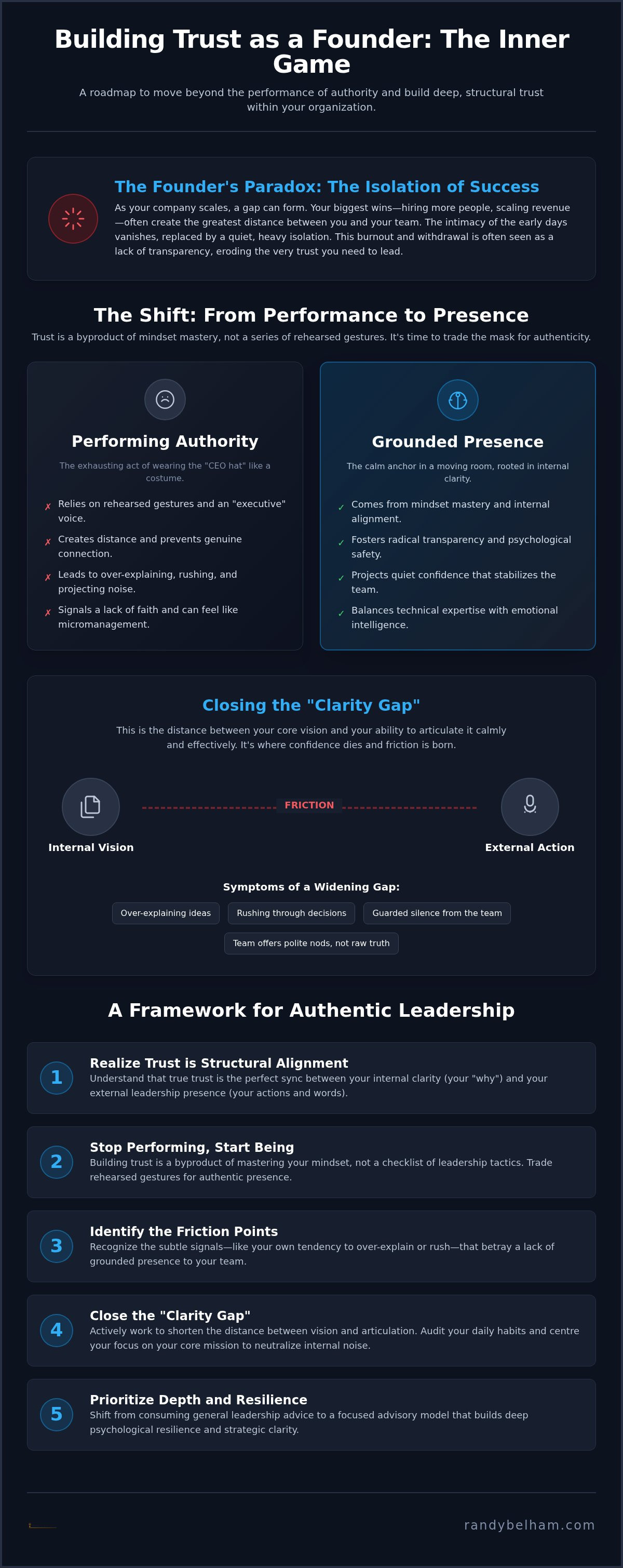
How to Build Trust as a Founder: A 5-Step Framework
Trust is not a soft skill. It is a structural byproduct of internal clarity. To move beyond the performance of authority, you need a method. Building trust as a founder requires a disciplined return to the basics of presence and mindset. This framework isn't about team-building exercises. It's about the mechanics of your own mind. It's about the inner game.
Step 1: Close the Clarity Gap. You cannot lead where you haven't been. Define your vision until it is a grounded reality in your own mind. If you are vague, you are untrustworthy.
Step 2: Audit Your Habits. Your calendar is a mirror. Build a routine that centres your focus daily. Trust is built in the consistency of your presence, not in grand gestures.
Step 3: Master the Inner Game. Use mindset coaching to neutralize the imposter syndrome that triggers defensive leadership. Silence the internal noise before it becomes external friction.
Step 4: Practise Grounded Communication. Speak to be understood, not to impress. Avoid the jargon. Use clear, simple language that invites alignment rather than awe.
Step 5: Seek a Private Advisor. You cannot see your own blind spots. Stress-test your presence with a peer-level expert who understands the weight of the crown.
Step-by-Step: From Internal Quiet to External Impact
Before you enter the boardroom, stop. Breathe. Realize that your nervous system dictates the room's energy. Practise a two-minute centring exercise: focus on the physical weight of your body in the chair. This creates a "calm anchor" effect. When you use executive decision making frameworks, you project a certainty that doesn't need to shout. Even the "Montreal Walk", the way you move between meetings in your office, should reflect this grounded presence. Be present in the transitions. Don't rush.
Refining Your Leadership Habits
An unflinching routine protects your mental edge. This might mean no devices before 8:00 AM or a specific physical environment that signals focus. Your office should be a sanctuary of clarity, not a chaotic hub of distractions. Physical space influences mental state. Building trust as a founder means being the person your team can rely on to be steady. Trust is a muscle requiring daily tension to remain strong. If you are ready to remove the mask and lead with authentic grit, explore how Empowered Leadership can stabilize your venture.
Sustaining Trust: Private Advisory and the Montreal Ecosystem
Trust is not a performance you perfect in a vacuum. It is a presence you embody in the room. Classroom theories fail when the pressure is real. In Montreal, where the startup community is tight and the stakes are high, building trust as a founder requires a mirror. You need a space where the mask can finally come off. This is the foundation of the 'Private Advisory for the Ten' model. Exclusivity isn't a marketing tactic. It's a requirement for depth. It creates the safety needed for true transformation.
Randy Belham works with a limited circle of ten founders at a time. This allows for a level of focus that traditional coaching cannot match. The work centres on the inner game of leadership. It is about moving from the intellectual concept of trust to the physical reality of authority. You don't just learn trust; you become the person people trust. This shift is what separates those who scale from those who stall.
The Case for a Confidential Advisor
Where do you go when the board is pushing and the team is wavering? Most founders have nowhere to be raw. A confidential advisor provides that sanctuary. Peer-level advisory is different from traditional consulting. Consultants focus on your spreadsheets. An advisor focuses on your state of mind. They help you navigate the hidden burdens of leadership with a sense of calm understanding. This is how you build sustainable leadership. It's about surviving the scale without losing your centre. It's about staying grounded while everything else is in motion.
Taking the Next Step in Montreal
Corporate training is designed for the middle. It offers generic solutions for specific pressures. It's often too loud and too shallow. When evaluating a confidential advisor for founders, look for experience, not just methodology. You need someone who has sat in the chair. Building trust as a founder starts with trusting your own counsel. It requires a disciplined approach to the inner game. If you're ready to close the gap between who you are and how you lead, it's time for a different conversation.
Availability is limited to maintain the integrity of the advisory. As of July 2026, spots for the upcoming cycle are being evaluated. This is a deliberate, methodical process for high-achievers who value focus over superficial metrics. Ready to close the gap? Apply for one of the ten private advisory spots.
Owning Your Presence: The Path Forward
Leadership isn't a costume. It's a frequency. We've seen how building trust as a founder requires moving beyond the theatre of authority to master the "Inner Game." True trust is the structural byproduct of closing your Clarity Gap. It's the result of neutralizing the internal noise that leads to reactive decisions. In the Montreal ecosystem, your team doesn't need a polished persona. They need a calm anchor.
Randy Belham provides a private sanctuary for those ready to remove the mask. This Montreal-based advisory is built on 30 years of business grit. It's designed for the specific weights of scaling. Exclusivity ensures depth. This is why Randy only serves ten founders at a time. Secure your seat where the conversation is raw and the focus is absolute. Apply for Private Advisory: Secure your spot among the ten.
You've built the venture. Now, build the presence that sustains it. The pressure is real, but you don't have to navigate it alone.
Frequently Asked Questions
What is the difference between executive presence and charisma?
Charisma is a performance of energy. Presence is the reality of stability. Charisma seeks to dazzle the room; presence seeks to ground it. One is a temporary attraction, while the other is a permanent anchor. Leaders who rely on charisma often struggle when the hype fades. Those with presence remain steady even in the quiet moments. They don't need to perform.
Can an introverted founder develop strong leadership presence?
Presence does not require volume. In fact, many introverts find building trust as a founder more natural because they value depth over noise. Presence is about the clarity of your internal state. When you are centred and certain, your team feels it. You don't need to be the loudest person in the room to be the most influential leader.
How long does it take to see results from executive coaching in Montreal?
Internal shifts happen during the first session. You'll feel a sense of structured quiet. Team perception usually follows within three to six months of consistent practice. Trust is a slow build. It requires you to move from learning to embodying your authority. The speed of change depends entirely on your commitment to the Inner Game. It's a disciplined process.
Is building trust about how I dress or how I act?
Trust is about alignment. Your attire is a professional signal, but your presence is the substance. If your external appearance is polished but your internal state is chaotic, the team will sense the friction. True authority comes from the centre. It's the byproduct of closing the Clarity Gap between who you are and what you say. Action follows being.
How does founder burnout affect my team's trust in me?
Burnout leads to emotional withdrawal. When you are exhausted, you stop communicating with clarity. You become reactive. Your team interprets this distance as a lack of transparency. They stop sharing the truth because they don't want to add to your burden. This creates a dangerous isolation. It erodes the foundation of your venture and your leadership presence.
Why do founders need different trust training than corporate managers?
Founders carry a unique psychological weight. Managers operate within a pre-built structure; founders are the structure. The stakes are personal. Building trust as a founder involves managing the identity trap where your self-worth is tied to the company's performance. Corporate training often misses this deep, visceral connection between the founder's mind and the organization's health. You need a peer, not a manual.
What are the most common trust roadblocks for Montreal tech founders?
Performance anxiety is the primary hurdle in Montreal's high-growth tech hubs. Founders often feel the need to perform leadership to satisfy investors or attract talent. This leads to over-explaining and rushing. These are tells of insecurity. When you stop trying to impress the room, you finally start leading it. Authentic grit replaces the rehearsed persona. It feels real.
How can I measure if my leadership presence is actually improving?
Watch the quality of the silence in your meetings. If it shifts from guarded and heavy to reflective and productive, you are making progress. Measure the speed of your decision-making. Clearer presence leads to less internal noise. When you can explain your vision without needing to persuade, your leadership has reached a new level of grounded authority. Results speak louder than words.


Comments