
Founder Decision Fatigue: Protecting Your Cognitive Capital in 2026

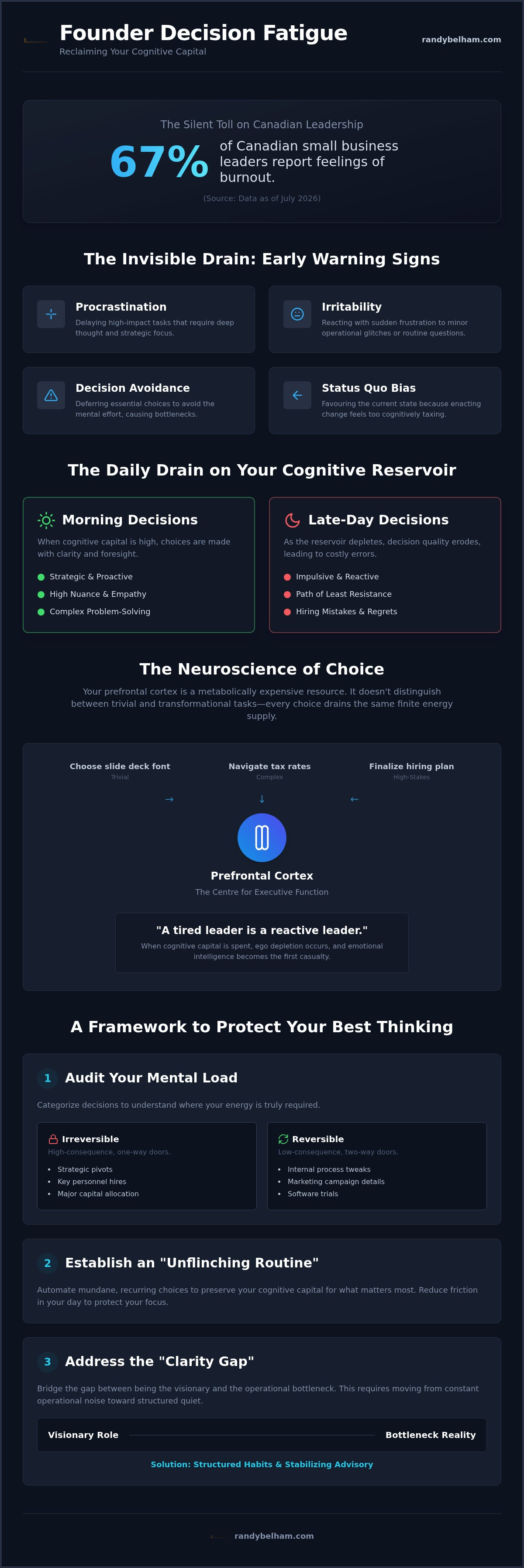
As of July 2026, 67% of Canadian small business leaders report burnout. The external metrics are climbing. The internal clarity is fading. You start your morning with a sharp, focused vision. By mid-afternoon, the fog arrives. You find yourself paralyzed by a trivial choice or, worse, regretting a strategy shift made during a late-day slump. This is the silent toll of founder decision fatigue. It's not a time management failure. It's a structural leak in your cognitive capital.
You recognize the weight of every choice, from navigating Quebec's new tax rates to finalizing a hiring plan. You don't have to lead from a place of exhaustion. You can regain your presence. This article will show you how to identify these mental drains. We'll build a framework to protect your best thinking time and establish the sustainable habits required for high-stakes leadership. It's time to move from the noise toward a sense of structured quiet.
Table of Contents
The Invisible Drain: Identifying Founder Decision Fatigue
The revenue is climbing. The quarterly reports show undeniable growth. Your external world is thriving. Inside, you feel a heavy, silent weight. You are staring at a simple email, unable to choose between two phrases. This is the first crack in the foundation. Decision fatigue is the psychological phenomenon where the quality of your choices deteriorates after a long period of decision-making. It isn't a lack of discipline. It's a biological limit. Your brain is a muscle. Like any muscle, it tires under a constant load.
Founders are uniquely vulnerable to this drain. The "buck stops here" reality means you are the final filter for every variable. In 2026, the volume of data is relentless. You navigate tax adjustments, remote team dynamics, and market shifts simultaneously. This constant processing leads to founder decision fatigue. It manifests as a visceral struggle hidden behind a mask of professional composure. You look like the "calm anchor" to your team, but the anchor is dragging. The strategy is sound. The strategist is fraying.
Early warning signs are often subtle. You might notice:
Procrastination on high-impact tasks that require deep thought.
Sudden irritability over minor operational glitches or staff questions.
Decision avoidance, where you defer essential choices to avoid the mental effort.
A tendency to favour the status quo because changing it feels too taxing.
The Cost of the 6:30 PM Decision
The choices you make at sunset are rarely as sharp as those made at dawn. Late-day exhaustion often leads to hiring mistakes or impulsive strategic pivots that you'll regret by Tuesday morning. Think of your mind as a reservoir. Once the water level drops, the nuance and empathy required for complex leadership are the first things to vanish. You begin choosing the path of least resistance because you lack the energy to weigh the alternatives. Cognitive capital is the finite daily currency of your executive function.
The Founder’s Paradox
Scale is supposed to bring freedom. Instead, it brings a geometric increase in variables. As your company grows, you don't make fewer decisions; you make more complex ones. You face a constant tension between being the visionary who sees the future and the bottleneck who slows down the present. This friction creates a "Clarity Gap" that drains your momentum. To bridge this, you need a structured approach to protect your focus. Implementing a founder clarity framework allows you to step out of the operational noise and back into the role of the steady, decisive leader your team requires. You must organize your life to protect your mind.
The Neuroscience of Choice: Protecting Your Reservoir
The prefrontal cortex is your internal boardroom. It's where you synthesize data, project futures, and exercise restraint. This region is metabolically expensive. It consumes a disproportionate amount of your body's energy. Every choice, no matter how small, draws from this same biological reservoir. Choosing a font for a slide deck drains the same energy as approving a merger. This is the core of founder decision fatigue. Your brain doesn't distinguish between the trivial and the transformational. It simply spends the capital. When the capital is gone, the quality of your leadership follows. The revenue is stable. The leader is volatile.
Cognitive load theory suggests our working memory has a strict limit. It can only hold a few pieces of information at once. When you overload this system with scheduling conflicts and minor emails, you leave nothing for high-stakes strategy. You aren't being lazy when you "simmer" on a complex problem. You are allowing your subconscious to process variables without the heavy metabolic cost of active deliberation. It is a physiological necessity. It is the only way to maintain a "calm anchor" in a high-velocity environment. It's about honouring the mechanics of the mind. Reflection is not a delay tactic. It is a strategic requirement.
Ego Depletion and Leadership
Willpower is a finite resource. When decision fatigue sets in, you experience ego depletion. Your internal filter thins. You might snap at a trusted partner or ignore a subtle cultural red flag. Your emotional intelligence is the first casualty of an empty reservoir. A tired leader is a reactive leader. Team culture suffers when the person at the centre can no longer regulate their responses. If you find your patience fraying, it's a sign your cognitive capital is spent. You lose the ability to lead with empathy. You become a bottleneck of frustration. The external optics are polished. The internal state is fragmented.
The High-Performance Mindset
Your primary role has shifted. You are no longer the one doing the work; you are the one deciding which work matters. This requires a different kind of labour. Elite performance requires recognized limits. You cannot be "on" for sixteen hours and expect your sixteenth hour to match your first. Realizing when your reservoir is at a critical level is a leadership skill. It's about presence. It's about knowing when to step back so you can step up later. Protecting your reservoir is not a luxury; it is your highest professional duty.
For those navigating these internal pressures, exploring ClearSight can offer the structural perspective needed to protect your mental energy and maintain your edge.
Auditing Your Mental Load: A Resource for Strategic Clarity
The balance sheet looks healthy. Your mind feels bankrupt. You are managing millions in capital, yet you are paralyzed by a minor software subscription choice. This is the "Clarity Gap" in action. It is the friction between your long-term vision and the daily noise that consumes your focus. To protect your cognitive capital, you must distinguish between tactical noise and strategic signals. Not every choice requires your full presence. Most decisions are reversible. They are "two-way doors" you can walk back through if needed. Agonizing over these is a primary driver of founder decision fatigue. Your energy belongs on the irreversible, high-stakes pivots that define your legacy.
Strategic clarity requires you to organize your day around "High-Stakes Windows." These are the two or three hours when your mental reservoir is at its peak. Stop answering non-urgent Slacks at 9:00 AM. You are spending your most expensive currency on penny-ante transactions. Move your board-level strategy, difficult personnel conversations, and financial planning into these windows. Everything else is secondary. The goal is to centre your focus on the "Inner Game" during high-pressure weeks, ensuring you aren't just busy, but effective. Silence the noise to hear the signal.
The Decision Audit Framework
You cannot manage what you do not measure. To regain control, perform a rigorous audit of your mental labour:
Step 1: Track. For 48 hours, record every single choice you make. From what you eat for breakfast to which candidate you approve.
Step 2: Assign Weight. Categorize each choice as High Impact (irreversible) or Low Impact (reversible). Be honest. Most are low.
Step 3: Identify Decision Debt. Look at the choices you've been avoiding. This is your "Decision Debt." It drains your background energy like an open tab on a browser.
Clarity Sessions for Executives
Sometimes you cannot see the label from inside the bottle. The mental noise becomes too loud to filter alone. This is where an external perspective becomes a structural necessity. A seasoned advisor acts as a mirror, helping you realize which "priorities" are actually distractions. By thinning out the clutter, you can address the root causes of founder decision fatigue before they lead to burnout. If you are ready to reclaim your edge, an executive decision making coach montreal can provide the framework to navigate these high-stakes choices with composure. You don't need more information. You need more clarity.
Habitualizing High-Performance: Systems to Automate the Mundane
High-level success requires low-level automation. The "Unflinching Routine" isn't about rigidity. It's about freedom. By automating the mundane, you eliminate the friction that leads to founder decision fatigue. Every morning, you have a choice. You can spend your cognitive capital on what to wear and what to eat, or you can save it for the board meeting at noon. The calendar is full. The mind must be clear. Designing a "Decision-Free Morning" ensures that your first three hours are spent in execution, not deliberation. You arrive at your high-stakes window with your reservoir intact.
Delegation is not just a management tool. It's a mental health strategy. You must move from being the primary decider to being the primary architect of systems. Implementing "Teaming Agreements" allows your leadership team to understand the boundaries of their authority. It empowers others to decide so you don't have to. This shifts your role from a bottleneck to a "calm anchor." You provide the direction. They provide the momentum. This structural alignment is what separates a reactive founder from a visionary leader.
Adopting a keynote speaker mindset means your habits must project the clarity you want your organization to mirror. If your internal world is chaotic, your company will follow. Discipline in your personal habits creates a ripple effect of stability. It's about reducing the weight of the "Inner Game" so you can focus on external growth. Systems are the only way to sustain high-velocity leadership without sacrificing your presence.
The Power of Pre-Deciding
Pre-deciding is the act of setting non-negotiable boundaries before the pressure mounts. Use "Rules of Thumb" for recurring operational issues. If a problem costs less than a specific dollar amount, your team handles it. If a request falls outside your quarterly goals, the answer is a default "no." These rules reduce the friction of daily life. They maximize your leadership grit by removing the need for constant negotiation with yourself. You decide once. You execute a thousand times.
Building Sustainable Leadership Habits
Elite performance requires recognized limits. You must integrate physical and mental "Rest Intervals" into your schedule. These are not breaks from work; they are essential maintenance for your executive function. Mindfulness is a tactical tool here, not a spiritual one. It allows you to sense when your reservoir is low before the fog sets in. When you learn how to stop overthinking business decisions, you begin to trust the systems you've built. You gain the confidence to lead with a sense of disciplined composure.
If you're ready to move from mental noise toward structured quiet, exploring Empowered Leadership can help you build the habits required for the long game.
Private Advisory: Restoring the Founder’s Edge in Montreal
Leadership in Montreal is a unique weight. You navigate a bicultural market, shifting provincial tax rates, and the high-velocity tech or industrial sectors. The 2026 drop in Quebec's small business deduction rate from 3.2% to 2.2% is just one more variable in an already crowded mind. This complexity accelerates founder decision fatigue. You don't need another consultant to give you a spreadsheet. You need a structural fix for your cognitive load. A private advisor acts as that fix. It's about moving from a state of mental noise to a sense of structured quiet. The city is in motion. You remain the calm centre.
Exclusivity is not a marketing tactic. It is a functional requirement for depth. Randy Belham limits his private advisory to a maximum of ten founders at any given time. This ensures a level of high-touch support that is impossible in a mass-market coaching model. When you are one of ten, you have a "calm anchor" who knows your board dynamics, your family pressures, and your specific internal triggers. We don't skim the surface. We go deep into the mechanics of your decision-making. The focus is on your presence, not just your performance. The business is scaling. The founder must not be shrinking.
The Confidential Partner
Isolation is the silent companion of the "buck stops here" reality. You need a safe space to process the "Inner Game" without the judgment of a board or the anxiety of a team. A confidential advisor for founders provides this sanctuary. We move beyond business metrics to address human performance. We look at the mechanics of your mind. We identify the leaks in your cognitive capital. It is a partnership built on 30 years of business experience and 20 years of coaching. You bring the ambition. We provide the structural quiet.
Taking the Next Step
Assessing your readiness for private advisory is simple. If you are successful externally but feel fragmented internally, the time is now. If you find yourself paralyzed by the sheer volume of trivial choices, your reservoir is empty. Beyond 1:1 support, Randy offers workshops and keynotes to bring these habits to your broader leadership team. This creates organizational alignment. It ensures your entire culture protects its collective cognitive capital. You stop being the bottleneck. You start being the visionary again.
The noise will not stop. The variables in the Canadian business landscape will only increase. You can choose to be reactive or you can choose to be disciplined. It's time to bridge The Clarity Gap. Your best thinking time is your most valuable asset. Honour it. Protect it. If you are ready to reclaim your edge, explore the ClearSight methodology and see what remains when the fog is gone.
Reclaiming Your Strategic Edge
The fog of 2026 is relentless. You have built a thriving organization. Now, you must build the structure to sustain yourself. Protecting your cognitive capital is the only way to maintain your edge. By auditing your mental load and habitualizing high-performance routines, you preserve your reservoir for the choices that define your legacy. The vision is vast. The focus is fragmented. It's time to align them.
Acknowledging founder decision fatigue is the first step toward reclaiming your presence. A biological reality. A structural response. You now have the framework to distinguish tactical noise from strategic signals. You have the systems to automate the mundane. Honour your best thinking time.
If you're ready to move from mental noise toward structured quiet, consider a confidential partner. Randy Belham offers specialized, Montreal-based private advisory limited to ten clients for maximum impact. Over 20 years of executive coaching experience. A grounded perspective for high-stakes leadership. Book a Private Advisory Session with Randy Belham to bridge your clarity gap and restore your focus. You have the vision. Now, secure the clarity to execute it.
Frequently Asked Questions
What are the first signs of founder decision fatigue?
The earliest indicators are procrastination on high-impact tasks and sudden irritability over minor operational glitches. You start your morning with a sharp vision. By mid-afternoon, you find yourself paralyzed by a trivial email or a scheduling conflict. This isn't laziness. It's a biological signal that your executive function is depleted. The fog arrives when your internal reservoir can no longer filter the noise.
How does decision fatigue impact my ability to lead a team?
It erodes your emotional intelligence and thins your internal filter. When your reservoir is empty, you lose the patience required for nuanced mentorship. You become a bottleneck. The team senses your volatility and stops bringing you complex problems to avoid reactive responses. Culture suffers when the person at the centre is too spent to lead with empathy. The leader becomes the friction.
Can decision fatigue lead to founder burnout?
Yes, persistent founder decision fatigue is a primary precursor to total leadership burnout. Recent data from July 2026 shows that 67% of Canadian small business leaders report experiencing some level of burnout. This often starts with the mental exhaustion of constant, high-stakes choice. When you ignore the drain on your cognitive capital, the weight becomes unsustainable. Eventually, the mental operating system simply crashes.
How do I distinguish between a strategic decision and tactical noise?
Apply the "Two-Way Door" framework to every choice on your desk. Strategic decisions are irreversible and high-impact; they define your long-term trajectory and legacy. Tactical noise consists of reversible, low-stakes choices like software subscriptions or minor marketing copy. If you can walk back the choice without significant damage, it is noise. Save your most expensive mental currency for the doors that lock behind you.
Is it possible to "recover" from decision fatigue during the workday?
Recovery requires a total cognitive reset, not just a brief distraction. Step away from all screens and inputs for at least twenty minutes. Physical movement or brief mindfulness sessions can help restore a small portion of your reservoir. However, the most effective recovery is preventative. You must protect your capital through structural habits and routines rather than trying to fix a deficit at 4:00 PM.
How can a private advisor help me manage my mental load?
A private advisor acts as a structural filter for your mental noise. They provide a safe, confidential space to process the "Inner Game" without the pressure of board members or employees. By acting as a calm anchor, they help you realize which priorities are actually distractions. This external perspective allows you to bridge the Clarity Gap and regain your edge. You move from noise toward structured quiet.
What is the "Clarity Gap" in decision-making?
The Clarity Gap is the friction between your high-level vision and the operational clutter that consumes your daily focus. It is the space where momentum is lost to indecision and overthinking. Closing this gap requires a shift from reactive fire-fighting toward intentional leadership. It involves building systems that automate the mundane so your mind remains free for the strategy that actually moves the needle for your organization.
Why do I struggle with overthinking even small business decisions?
Overthinking small choices is a classic symptom of founder decision fatigue. Your brain has lost the capacity to distinguish between the trivial and the transformational. Every choice feels weighted with equal significance because your executive function is fraying. It is not a lack of intelligence or experience. It is a physiological sign that your cognitive reservoir is dangerously low. Your mind is simply tired of choosing.


Comments