
Founder to CEO: Navigating the Mindset Shift Required for Scale
- Randy Belham

- Jul 20
- 12 min read
Updated: 7 days ago
Your ability to solve every problem was once your greatest asset. Now, it is your greatest liability. You built a company on the strength of your hands and the speed of your decisions. Yet, as the business grows, you feel the walls closing in. You are the bottleneck. Every minor choice requires your approval. The operational noise is deafening. You realize that the very grit that got you here is now preventing you from going further.
It is a heavy burden to carry. You feel guilty when you delegate. You fear the loss of quality. You are burnt out, yet you cannot let go. Navigating the founder to ceo mindset shift is not about learning new software or hiring more staff. It is a psychological transition from being the hero to becoming the architect. This article provides a clear framework to help you master the inner game of scaling. We will explore how to reduce your mental load and regain the clarity needed to lead with presence while your business grows without your constant intervention.
Table of Contents
The Founder's Paradox: Why Your Greatest Strengths Become Your Biggest Blockers
You built this. Every client, every product line, and every breakthrough carries your fingerprints. Your grit was the catalyst. Your obsession was the fuel. On the surface, the business is thriving. Revenue is climbing. The team is expanding. Yet, internally, you are exhausted. You feel like a passenger in a vehicle you are supposed to be driving. This is the founder's paradox. The very traits that made you successful are now the primary obstacles to your growth.
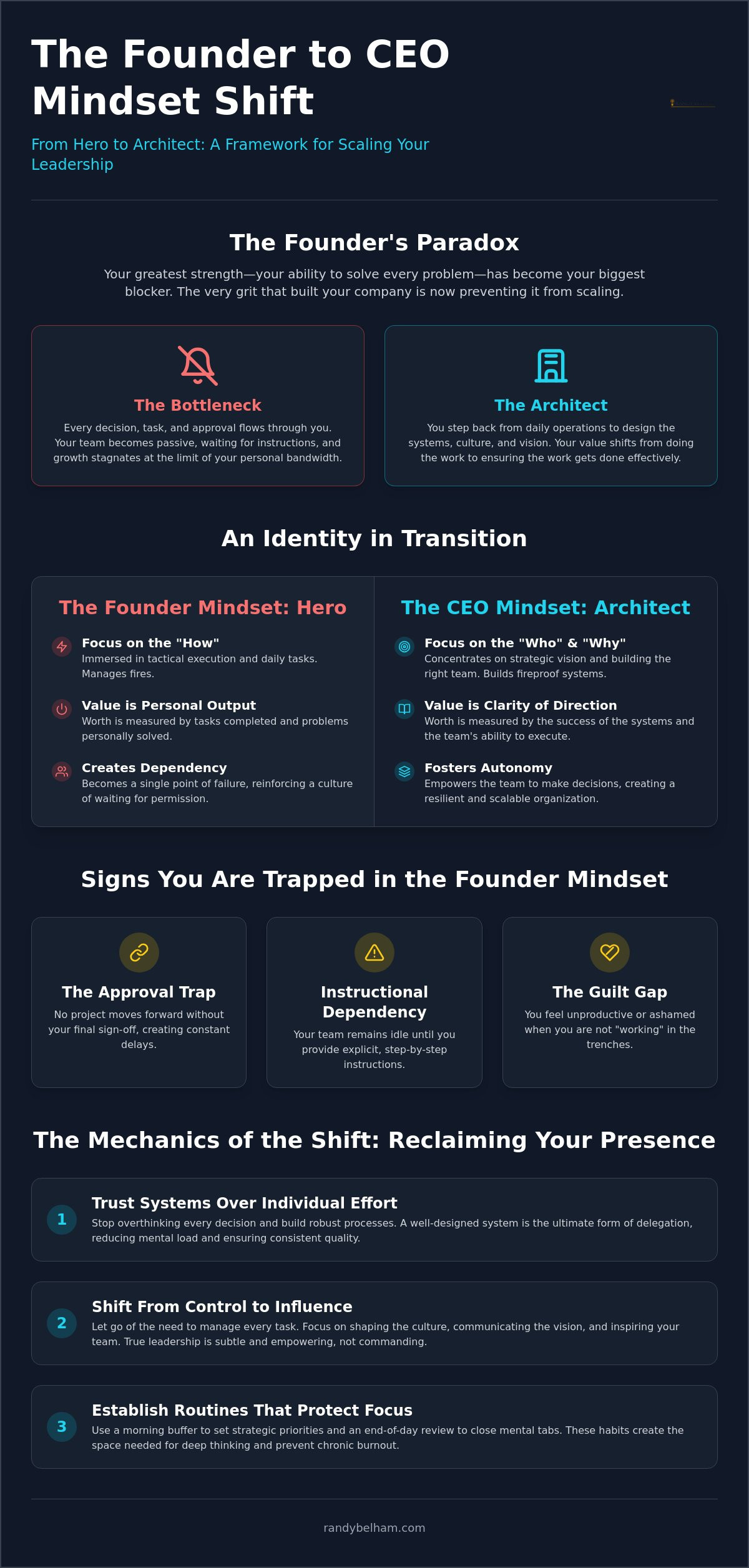
In the early days, being the "Hero" was a necessity. You were the primary problem-solver because there was no one else. This role fed your ego. It felt good to be the one with all the answers. But as you scale, this identity becomes a cage. When you remain the central point of every decision, you stop being a leader and start being a bottleneck. A deeper understanding entrepreneurship reveals that while the first stage is about personal execution, the second is about organizational architecture. If you don't evolve, the business plateaus. Your team becomes passive. They wait for your instructions. They stop thinking because you do the thinking for them.
Montreal founders face a unique cultural tension. There is often a deep pride in being "hands-on" or maintaining a boutique, craftsman-like feel. You might fear that becoming a "corporate leader" means losing your soul. It doesn't. It means protecting the vision by stepping away from the noise. The founder to ceo mindset shift is an identity transition. It is the difficult move from "doing" to "ensuring it gets done." Without this shift, the cost is high. You face burnout. High-performing talent leaves because they have no room to breathe. Revenue stagnates because the business cannot outgrow your personal bandwidth.
The Difference Between Founder and CEO Mindsets
The founder is a tactical player. They are reactive, focusing on the "how" of every task. They live in the trenches. The CEO is a strategic coach. They are proactive, focusing on the "who" and the "why." One manages fires; the other builds the fireproof system. Much like how Energy Control Systems protects industrial infrastructure from external shocks, a CEO protects the organization from operational noise. Transitioning means realizing your value is no longer measured by your output, but by the clarity of your direction.
Signs You Are Trapped in the Founder Mindset
The Approval Trap: No project can move forward without your final sign-off.
Instructional Dependency: Your team remains idle until you tell them exactly what to do.
The Guilt Gap: You feel a visceral sense of shame when you aren't "working" in the trenches alongside your staff.
You realize the status quo is unsustainable. You want to lead, but you are too busy managing. To scale, you must let the "Hero" die so the "Architect" can live.
Scaling the Business Owner Mindset: Navigating the Identity Crisis
Scaling a business is an external metric. Scaling a mindset is an internal war. Most advice focuses on the mechanics of delegation. They tell you to trust your team. They ignore the quiet panic that sets in when you finally do. If you are not the smartest person in the room, what is your value? If you aren't the primary problem-solver, why are you there? This is the identity crisis at the heart of the founder to ceo mindset shift.
You have spent years equating your worth with your output. Now, your value must move from output to insight. It is a shift from the tangible to the abstract. You are no longer building the product. You are building the machine that builds the product. This requires a specific type of entrepreneur mental resilience. It's the ability to sit with the discomfort of not "doing" while remaining deeply engaged in "leading." Your internal narrative is the ceiling of your company's growth. If you believe you are the only one who can save the day, you will subconsciously create fires to extinguish. You must master the inner game before you can master the market.
Letting Go of the 'Hero' Narrative
There is a dopamine hit in saving the day. It feels good to swoop in and fix a crisis. But every time you do, you reinforce a culture of dependency. You become a single point of failure. The shift from control to influence is painful. Control is certain. Influence is subtle. To scale, you must build a culture where you are the least necessary person in the operational loop. You are moving from the centre of the storm to the calm anchor on the shore.
The Role of Emotional Intelligence in Scaling
Success often leads to a strange anxiety: the empty calendar. As a founder, a busy day felt like progress. As a CEO, empty space is your most valuable asset. It is where strategy happens. You need the emotional intelligence to manage the urge to fill that space with busywork. You also need the patience to let others fail. True developing a founder's mindset involves watching a team member take a sub-optimal path and allowing them to learn from it. It's a long-term investment in their growth. If this transition feels heavy, engaging in private coaching can provide the objective mirror needed to navigate the shift.
The Mechanics of the Shift: From Operational Noise to Strategic Presence
Your inbox is a graveyard of other people's problems. You are busy. You are active. Yet, the needle hasn't moved in months. This is the noise. It is a seductive trap for founders because it feels like progress. To scale, you must trade the dopamine of the "quick fix" for the discipline of strategic presence. The founder to ceo mindset shift requires you to stop being the engine and start being the navigator. You are no longer paid to work; you are paid to think.
The High-Impact CEO Framework narrows your focus to three levers: Strategy, Culture, and Capital. If an issue doesn't touch one of these, it doesn't belong on your desk. This transition demands that you stop overthinking business decisions by trusting the systems you've built. A 2025 survey of CEOs indicated a strategic shift towards localization and regionalization. In Montreal, this is your leverage. You can utilize deep local networks and regional insights, but only if you maintain enough executive distance to see the board clearly. If you are buried in the "how," you will miss the "where."
Operational Noise vs. Strategic Clarity
Low-value tasks often masquerade as urgent work. They demand your attention but offer zero ROI on your vision. You must protect your cognitive capacity. Implementing a "CEO Day" is a non-negotiable weekly ritual for high-level thinking. It is a day of zero meetings and zero "open doors." By using a founder performance coaching lens, you can audit your schedule to ensure your energy matches your priorities. High-stakes leadership requires a mind that is quiet, not cluttered.
Building Systems of Accountability
Scaling requires you to move from micro-management to metric-management. You don't need to know what your team is doing every hour. You need to know if they are hitting the numbers. This means empowering your first layer of leadership with real authority. If they have to ask permission for every expense, they aren't leading. Use the "Decide Once" principle for recurring hurdles. Create a policy, set a metric, and let the system handle the rest. This creates the space you need to focus on the 52% of CEOs who are currently accelerating portfolio transformations to navigate economic volatility.
Habit Formation for the Scaling Executive
Habits are the quiet architecture of your day. They define your capacity. For the founder, habits were about speed. For the CEO, they are about regulation. This is where the founder to ceo mindset shift becomes a lived reality. It is not a one-time decision. It is a daily practice. You are no longer sprinting. You are pacing for a marathon. Your rituals must reflect that endurance.
The world is loud. Your inbox is a storm. You must be the calm anchor. A morning buffer is your shield. One hour of silence. No digital noise. No Slack. This ritual grounds your presence before you step into an investor pitch. It ensures you lead the room instead of reacting to it. Equally critical is the end-of-day review. Close the mental tabs. Burnout is the weight of unresolved thoughts. Spend ten minutes reviewing the day. Document the tensions. Release the pressure. A scaling CEO cannot afford a cluttered mind during their recovery time.
You are a high-performance asset. Your body is the engine. Recovery is part of the job. Sleep is a strategic advantage. Movement is a mental reset. If you ignore your health, you ignore your business. You cannot lead a team to scale if you are operating on fumes. Wellness is not a luxury. It is a functional requirement for high-stakes leadership.
Cognitive Habits for Better Decision-Making
Practise strategic boredom. Put the phone away. Sit with your thoughts. Breakthroughs happen in the gaps between tasks. Use the pre-mortem habit. Stress-test your decisions. Imagine the failure before it happens. It is not pessimism; it is preparation. Maintain a decision journal. Track your judgment. Why did you make that call? What were the variables? This habit builds pattern recognition. It turns intuition into a measurable skill. It allows you to refine the machine that is your mind.
Communication Habits for Leaders
Be the last to speak. Listen first. Your team needs to find their voice. If you speak first, you silence them. Move from checking up to checking in. One is about control. The other is about support. Build a habit of radical candour. Direct feedback. Empathetic delivery. It removes the friction of ambiguity. When you communicate with clarity, you build a culture that can survive without your constant intervention.
Mastering these repetitions is the work of a professional. If you are ready to refine your executive habits and close the gap in your leadership, explore 1:1 private coaching to accelerate your transition.
Closing the Clarity Gap: The Role of Private Advisory in the Shift
The view from the top is clear. The view of yourself is often blurred. You have reached the limits of your own perspective. The founder to ceo mindset shift is the most significant psychological transition you will ever make. It is a heavy lift. It is too heavy to carry alone. Most founders try to white-knuckle this phase. They fail. Not because of a lack of skill, but because of a lack of distance.
You need an unflinching mirror. Your team cannot provide it; they are too close to the flame. Your board cannot provide it; they are focused on the exit. A private advisor acts as the calm anchor while everything else is in motion. This relationship allows you to identify The Clarity Gap. This is the distance between your current operational reality and the strategic leader you must become. Closing this gap requires more than just better habits. It requires a fundamental reorganization of your internal narrative. You must move from the noise of the "now" toward the quiet of the "next."
Why Peer Groups and MBAs Aren't Always Enough
Peer groups offer consensus. MBAs offer curriculum. Neither offers private clarity. Group settings are valuable for networking, but they rarely provide the safety needed to discuss the raw struggles of the inner game. You don't need a group's opinion on your strategy. You need a confidential space to stress-test your judgment. Generic academic frameworks often fail because they don't account for the unique emotional weight of your specific organization. Tailored systems, built through one-on-one advisory, scale far better than a generic syllabus.
Mastering the Transition in Montreal
Montreal's entrepreneurial ecosystem is tight-knit and high-pressure. The cultural nuances of the market demand a leader who is both deeply connected and strategically distant. You are building a legacy. This legacy must outlast your daily involvement. It must survive your absence. To reach this stage, you must be willing to confront the barriers in your own mind. This is the work of a seasoned high-achiever. It is a commitment to depth over superficial metrics. It starts with a single, honest assessment of your current mindset readiness. If you are ready to stop being the hero and start being the architect, the path forward is clear.
Mastering the Architecture of Scale
Your business has outgrown its origin. Your role must follow. The heroics of the startup phase are now the primary barriers to your future. To scale, you must trade the dopamine of the fix for the discipline of the vision. Navigating the founder to ceo mindset shift is the final hurdle in your leadership evolution. It is the move from doing to architecting. It is the move from noise to quiet.
You don't have to navigate this transition in isolation. I provide a grounded, private space for high-achievers to master the inner game of leadership. This advisory is built on 30 years of business experience and is strictly limited to 10 private clients to ensure deep, personalized impact. We focus on the mechanics of the mind and the practicalities of high-stakes decision-making.
Bridge the gap between founder and CEO with private advisory in Montreal.
The machine you built is ready to grow. Now, it's time to build the leader who can guide it. The clarity you need is waiting on the other side of the shift.
Frequently Asked Questions
What is the difference between a founder mindset and a CEO mindset?
The founder mindset is rooted in tactical execution; the CEO mindset is defined by strategic architecture. A founder focuses on the "how" of daily operations. A CEO focuses on the "who" and the "why" of the organization's future. This founder to ceo mindset shift requires moving from being the primary problem-solver to the primary visionary. It is the difficult transition from personal output to organizational insight.
When is the right time to make the shift from founder to CEO?
The right time to shift is when your personal bandwidth becomes the ceiling for company growth. If every decision requires your approval, you've reached that limit. You'll notice growth plateaus despite increased effort. This is the signal to step back. You must move from the centre of the storm to the calm anchor on the shore to allow the business to breathe and expand.
How do I stop being the bottleneck in my own business?
You stop being the bottleneck by delegating authority, not just tasks. Most founders mistake assignment for delegation. True delegation means giving your team the power to fail and the space to learn. You must build systems of accountability based on metrics rather than micro-management. Trust the machine you built. When you stop intervening in every minor choice, the business gains the velocity it needs to scale.
Is it possible to scale a business without losing the founder's passion?
It is possible, but your passion must evolve. You move from being a craftsman of the product to being an architect of the culture. The scale doesn't kill passion; it amplifies it through the hands of others. You find a new kind of fire in seeing your vision take root in a team that operates with independence and clarity. Your passion becomes the fuel for the machine's long-term direction.
What are the most important habits for a scaling CEO?
The most critical habits involve protecting your cognitive capacity. A morning buffer of silence prevents you from starting the day in a reactive state. An end-of-day review allows you to close mental tabs and prevent the accumulation of stress. These rituals foster the presence needed for high-stakes leadership. Successful CEOs prioritize strategic boredom to allow for the creative breakthroughs that drive organizational transformation.
How can an executive coach help with the founder-to-CEO transition?
An executive coach provides the unflinching, external perspective that a founder cannot find elsewhere. They act as a mirror for your blind spots. By identifying the Clarity Gap, a coach helps you navigate the psychological burdens of leadership. They guide you through the founder to ceo mindset shift by focusing on the inner game. This support ensures you remain steady while everything else is in motion.
Why do most founders fail to make the shift to CEO?
Most founders fail because they cannot release the "Hero" identity. They are addicted to the dopamine hit of saving the day. This fear of irrelevance keeps them trapped in the trenches. If they aren't the smartest person in the room, they don't know their value. This ego-driven attachment to control kills scale. Without an internal identity transition, the founder becomes the very obstacle they are trying to overcome.
Does scaling a business always lead to founder burnout?
No. Scaling only leads to burnout when you refuse to evolve your role. Burnout is the result of carrying operational noise that no longer belongs to you. When you master the mechanics of the shift, you find more space, not less. Scale should lead to structured quiet and increased presence. It is the refusal to delegate and the insistence on being the central point of failure that causes exhaustion.


Comments