
Founder Leadership Challenges: Navigating the Inner Game of High-Stakes Growth

Updated: Jul 31
The revenue is climbing. Your internal clarity is fading. You have built a machine that demands your constant attention, yet you feel increasingly detached from the person running it. It's a common paradox. You are performing the role of a leader while privately drowning in decision fatigue. These founder leadership challenges are rarely about a lack of skill. They are symptoms of an unmanaged internal landscape.
You likely feel that the isolation of the top seat is simply the price of success. It doesn't have to be. You can move beyond the feeling of "performing" leadership and start embodying it. This article will show you how to transform psychological pressure into grounded authority by placing yourself at the centre of your leadership experience. We will explore how to achieve internal silence, reduce boardroom anxiety, and build a sustainable structure that prevents burnout before it starts.
Table of Contents
The Weight of the Crown: Identifying Unique Founder Leadership Challenges
The valuation rises. Your confidence wavers. This is the central paradox of scaling a business. As the company expands, the psychological weight on the founder doesn't just increase; it mutates. You are no longer solving product problems. You are solving people problems, culture problems, and the problems within your own mind. These founder leadership challenges are unique because they are tied to your identity. A CEO hired from the outside can leave the office. A founder carries the office in their chest.
External wins often mask internal doubt. In the boardroom, you are the authority. In your head, you are a builder who got lucky. This imposter syndrome isn't a sign of weakness. It's a sign of a high-stakes environment where the old rules no longer apply. You are moving from the "doing" phase to the "leading" phase. It's a painful shift. It requires you to stop being the hero of the story so your team can find their own strength. The crown is heavy because it doesn't just sit on your head; it sits on your heart. Every hire, every pivot, and every missed target feels personal. You aren't just managing a P&L. You are managing the dreams of your employees and the expectations of your investors.
The Founder Isolation Gap
Your board demands results. Your team looks for certainty. Neither can truly hold the space for your unfiltered reality. This creates a dangerous isolation. When you have no one to speak the truth to, you enter an echo chamber. Every decision feels heavier because you are carrying it alone. This is why founder isolation support is a structural necessity for growth. Without a confidential peer, the silence of the top seat becomes deafening. You need a space where you don't have to perform leadership, but can simply exist within it.
The Identity Crisis of the Scaling Leader
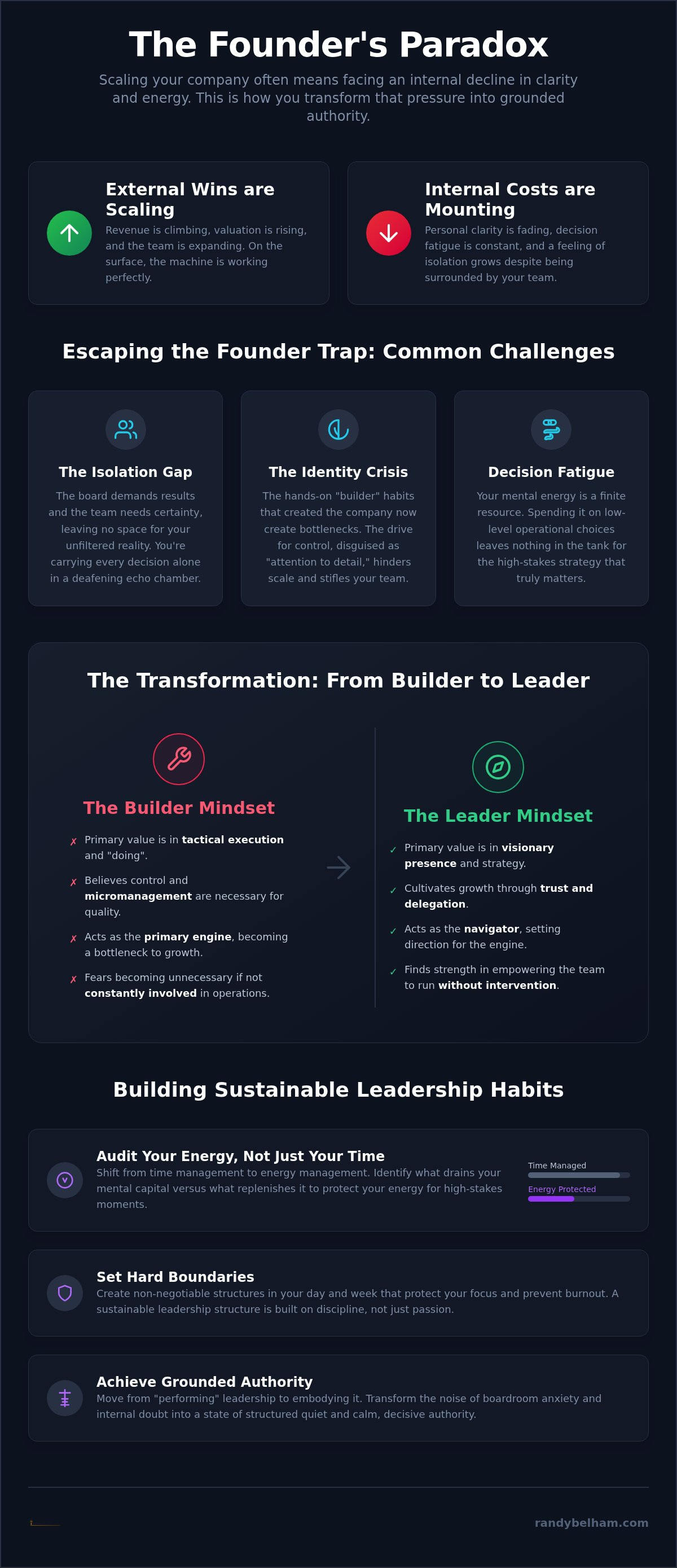
The habits that built the company often hinder its scale. You were the primary builder. You were in the trenches, making every call. Now, that same drive for control creates a bottleneck. You feel the pull to micromanage because it feels safer than leading. This is where decision fatigue takes hold. You spend your mental capital on low-level operational choices, leaving nothing for high-stakes strategy. Realize that your ego often disguises itself as "attention to detail." Letting go is the only way to gain true strategic presence. You must learn to trust the systems you've built, even when they don't look exactly like your own hands-on labour.
The Psychology of the Scale: Moving from Builder to Leader
Growth is a paradox. You built the machine with your own hands. Now, to keep it moving, you must stop touching the gears. This is the "Founder Trap." Your desire for perfection was an asset during the seed stage. In a high-growth environment, it's a bottleneck. If every significant decision must pass through your desk, the pulse of the company slows to your personal bandwidth. You aren't just managing a team; you're unintentionally stifling it. These founder leadership challenges are often rooted in a refusal to evolve your internal identity from builder to pilot.
The shift from tactical execution to visionary presence is uncomfortable. Execution is safe. It's measurable. Visionary presence feels vague and vulnerable. It requires you to sit with the silence of high-level strategy while your team handles the noise of daily operations. Many founders resist this because of a quiet, persistent fear: the fear of being unnecessary. If the company runs without your constant intervention, who are you? Realize that your value has changed. You are no longer the primary engine. You are the navigator ensuring the engine is pointed in the right direction. Developing the emotional intelligence to manage this transition is what separates a founder who burns out from one who scales.
Mastering the Inner Game of Performance
Technical skill got you to Series A. Mental resilience will get you to the exit. During a scale-up, your internal state is your most important business asset. If you are reactive, the company becomes chaotic. Maintaining authority during a crisis requires a sense of internal silence that most leaders never develop. It's about becoming the calm anchor while everything else is in motion. This level of psychological discipline is the focus of founder performance coaching, where the goal is to master the inner game before the outer game overwhelms you.
The Art of Relentless Delegation
Delegation isn't about offloading tasks. It's about offloading control. This is a psychological hurdle, not an operational one. You must confront the barriers that prevent you from trusting your senior leadership team:
The belief that "no one can do it as well as I can."
The fear of losing visibility into the "truth" of the business.
The anxiety of being held responsible for someone else's mistake.
Building a culture of accountability requires you to use clarity as a tool. When your vision is clear, your team doesn't need your permission; they only need your alignment. Achieving this level of operational freedom is a core pillar of
, allowing you to lead from a place of presence rather than panic.
Decision Fatigue and the Clarity Gap in High-Stakes Environments
The calendar is full. The mind is empty. This is the daily reality of high-stakes growth. You make hundreds of choices between sunrise and sunset. By the late afternoon, your cognitive reserves are depleted. Your 4:00 PM choices are your most dangerous. They are often reactive. They lack the nuance and strategic depth of your morning clarity. This exhaustion isn't just a personal burden; it is one of the most persistent founder leadership challenges in the Montreal market. When the leader is tired, the company's direction becomes blurred. You start choosing the path of least resistance rather than the path of maximum impact.
Overthinking erodes your presence. Your team senses the hesitation. They need a calm anchor, not a second-guesser. When you dwell on a decision for too long, you aren't being diligent. You are being fearful. This internal noise creates a ripple effect throughout the entire organization. It slows down execution. It kills momentum. It signals to your senior leadership that you don't trust the systems you've built. A framework for high-pressure decision-making isn't a luxury. It's a survival tool. It allows you to move from a state of mental clutter toward a state of grounded authority. You must protect your mental capital with the same intensity you protect your cash flow.
Eliminating Mental Noise
Busy is not effective. High-growth founders often confuse movement with progress. True executive effectiveness requires a quiet mind and a disciplined focus. You must learn to stop overthinking business decisions and start trusting your professional intuition. Intuition is not a guess. It is pattern recognition at speed. It is the result of your decades of business experience. Don't drown that signal in unnecessary data. Listen to the insight, ignore the noise, and move forward.
Closing the Clarity Gap
Your vision is clear to you. It is often a mystery to your team. As the organization scales, the "Clarity Gap" widens. What you say in the boardroom is not always what is executed on the floor. This misalignment leads to wasted labour, frustrated talent, and missed targets. Realignment requires deliberate space and structured reflection. Regular executive clarity sessions help bridge this divide. It's about ensuring the vision in your head matches the execution on the ground. Without this bridge, you aren't leading a company. You are just hoping it follows you.
Building Sustainable Leadership Habits for the Long Game
The external growth is visible. The internal erosion is quiet. You cannot lead a high-growth company on adrenaline alone. Adrenaline is for sprints. Sustainable authority is for the marathon. To survive the long game, you must move beyond the "hustle" and toward a structured quiet. Addressing founder leadership challenges requires more than a better task manager. It requires a fundamental shift in how you inhabit the role. You are the architect of the culture. If your personal foundation is cracked, the building will eventually lean.
Establishing sustainable habits is about protecting your most valuable asset: your mental clarity. This process involves five critical steps:
Step 1: Audit your energy, not just your time. Time is a fixed schedule. Energy is the currency of high-stakes choices. Identify the meetings that drain your capital and the deep work that restores it.
Step 2: Define hard boundaries. You are the founder. You are also a person. When these identities merge, the business's failure becomes a personal crisis. This creates a state of chronic anxiety that cloud's judgment.
Step 3: Establish a percussive, minimalist communication rhythm. Say what needs to be said. Then stop. Minimalist communication creates the necessary space for your senior team to actually lead.
Step 4: Prioritize internal regulation. Disciplined habits aren't just for productivity. They are for sanity. A regulated nervous system is the difference between a reactive pivot and a strategic move.
Step 5: Seek an external "calm anchor." You need a peer who has no stake in your equity, only in your clarity. This perspective provides the unflinching truth that your board and team cannot offer.
The Unflinching Routine
Rituals survive crises. Decisions don't. When the pressure is high, your willpower will fail you. Your routine must be the safety net. Design a schedule that protects your capacity for deep work before the noise of the day begins. Physical wellness is not a hobby or a luxury. It is the baseline for cognitive performance. If your body is failing, your leadership will follow. A tired mind cannot see the "Clarity Gap" we discussed earlier; it only sees the next fire to put out.
Sustainable Authority
You can lead with grit. You shouldn't lead with exhaustion. Reactive leadership is a sign that your internal regulation has failed. You are no longer driving the company; the company is driving you. Mastering the "inner game" allows the business to outlast the current pressure and scale toward a meaningful exit. To build this sustainable structure and reclaim your presence, explore Empowered Leadership as a framework for your continued growth. It's about moving from a state of constant motion to a state of purposeful direction.
The Path to Grounded Authority: Private Advisory for Montreal Founders
The company is scaling. The founder is shrinking. This is the quiet reality of high-stakes growth in the Montreal market. Most corporate training programs fail the high-growth founder because they are built for managers. They focus on HR checklists and general communication tools. They ignore the visceral, psychological weight of the top seat. Solving founder leadership challenges requires more than a workshop. It requires a safe harbour. You need a confidential space where you can stop performing the role and start embodying the authority required to lead. Moving from a state of performance to a state of presence is not a tactical shift. It is a psychological one.
Randy Belham offers a limited-capacity private advisory for up to ten founders. This exclusive focus ensures a high-touch partnership that mirrors the intensity of your business. It is a relationship built on depth, not volume. When you are navigating the complexities of a scale-up, you don't need a distant consultant. You need a peer who understands the unflinching reality of being the one where the buck stops. This is about creating a sense of structured quiet in the middle of the noise. It is about becoming the calm anchor that your team, your board, and your family deserve.
The 1:1 Advantage for High-Achievers
Peer-level advisory is the only effective solution for the isolation of the top seat. With 30 years of business experience and 20 years of coaching, Randy focuses on the psychological mechanics of your specific leadership style. Montreal founders choose this percussive, direct approach because it respects their time and their intelligence. We don't discuss theories; we address the internal pressures that cloud your decision-making. We look at the mechanics of the mind to ensure your external actions are grounded in internal clarity. This is not career coaching. It is the mastery of your inner game.
Closing the Distance to Your Vision
Your potential is often trapped behind the noise of daily operations. The ClearSight methodology is designed to close the distance between your current state and your ultimate vision. It provides the framework to identify your "Clarity Gap" and bridge it with grounded authority. Having a calm anchor in your corner provides an immediate impact on your boardroom presence and your personal health. You can stop reactive habits and start proactive leadership. To begin this transition and reclaim your professional focus, book a discovery session with Randy. Reclaim the silence. Lead with presence.
Reclaiming the Centre of Your Leadership
The company is expanding. Your presence is thinning. You now understand that the habits of a builder often hinder the growth of a leader. Navigating founder leadership challenges requires a shift from tactical noise to strategic quiet. It requires you to protect your energy with the same intensity you protect your capital. True authority isn't about doing more. It's about being more focused.
Randy Belham acts as the calm anchor for high-achievers who have outgrown generic advice. His advisory is limited to a maximum of 10 clients to ensure a deep, personalized focus. He brings 30 years of business experience and 20 years of coaching mastery to the "inner game" of Montreal’s high-growth founders. It's your opportunity to move beyond the performance and start leading from a place of grounded authority.
Book a private advisory discovery session with Randy Belham to realign your path and reclaim your clarity. You have built the machine. Now, it's time to lead it with a quiet mind.
Frequently Asked Questions
What are the most common leadership challenges for founders in 2026?
Rapid technological shifts and the resulting psychological strain are the primary hurdles. Founders must manage the "Clarity Gap" while navigating decentralized teams and heightened investor expectations. These founder leadership challenges require a shift from operational control to strategic presence. It is about maintaining an internal silence despite the external noise of a volatile market.
How does founder isolation affect business decision-making?
Isolation creates an echo chamber that distorts risk assessment. Without a confidential peer to provide an unflinching perspective, you rely on a team that is often too close to the problem or too dependent on your approval. This lack of external friction leads to reactive choices. You lose the ability to see your own blind spots, which eventually erodes boardroom confidence.
Can leadership presence be developed, or is it a natural trait?
Leadership presence is a skill developed through disciplined internal regulation. It is not an innate trait but a byproduct of grounded authority and psychological clarity. You learn to inhabit the role by silencing the "performer" and embodying the "anchor." This transition requires intentional practice and a willingness to confront the mental mechanics that drive your reactions during a crisis.
What is the best way for a founder to overcome decision fatigue?
Protect your mental capital by automating low-stakes choices and auditing your energy. You should reserve your cognitive resources for the high-impact decisions that define your vision. If you find yourself making critical calls late in the afternoon, you are operating in a deficit. Establish a percussive routine that prioritizes deep work and allows for periods of cognitive recovery.
How do I know if I need a private advisor or a business consultant?
A business consultant fixes your systems; a private advisor fixes the person running them. If your challenges are purely operational, hire a consultant. If you feel the weight of the crown or struggle with internal clarity, you need an advisor. This partnership focuses on the psychological mechanics of leadership and the "inner game" that determines the company's long-term survival.
What are the signs of founder burnout before it happens?
Chronic cynicism and a persistent feeling of detachment are the earliest indicators. You might notice your decision-making has become reactive rather than proactive. If the business feels like a burden rather than a mission, your foundation is likely cracking. Burnout is a structural failure of leadership habits. It manifests as a mental noise that prevents you from finding quiet.
How does emotional intelligence impact a founder’s ability to scale?
Emotional intelligence allows you to navigate high-pressure team dynamics without losing your authority. As you scale, your technical skills become less relevant than your ability to manage the gap between your vision and your team's execution. High EQ leaders recognize when their ego is driving a decision. They choose alignment over control, which is essential for sustainable growth.
Why is Montreal a unique environment for entrepreneurial leadership challenges?
Montreal features a distinct blend of European business culture and North American growth expectations. This creates a specific pressure for founders to be both highly sophisticated and aggressively competitive. The local ecosystem is tight-knit, which can often amplify the feeling of "performing" leadership. Navigating these founder leadership challenges in Quebec requires a nuanced understanding of local corporate dynamics and personal reputation.


Comments