
Founder Coach vs. Therapist in Montreal: Which Does a High-Stakes Leader Need?
- Randy Belham

- 5 days ago
- 11 min read
The revenue is growing. The pressure is mounting. You've reached the limit of your own internal processing. Many Montreal leaders find themselves stuck in a cycle of chronic overthinking. They wonder if they need a founder coach vs therapist montreal to navigate the path forward. You likely feel that traditional therapy doesn't quite grasp the velocity of your business day. It's a specific, quiet kind of isolation.
You're looking for mental clarity. You don't need a diagnosis; you need an architect for your performance. This article explores the distinct boundaries between clinical healing and performance architecture. We'll help you realize which path fits your current season. We will look at the unique pressures of the local ecosystem and how to build sustainable habits that survive the stress of a scale-up.
Table of Contents
The Blurred Line: Why Montreal Founders Question the Need for Support
Success is visible. Internal noise is deafening. You lead a team of fifty. You cannot lead yourself to sleep. This is the Founder’s Paradox. Your P&L shows growth; your mental state feels like a deficit. High-achievers often reach a point where the weight of responsibility exceeds their internal infrastructure. They start searching for a founder coach vs therapist montreal because they know something is wrong. They just don't know if they need a healer or an architect.
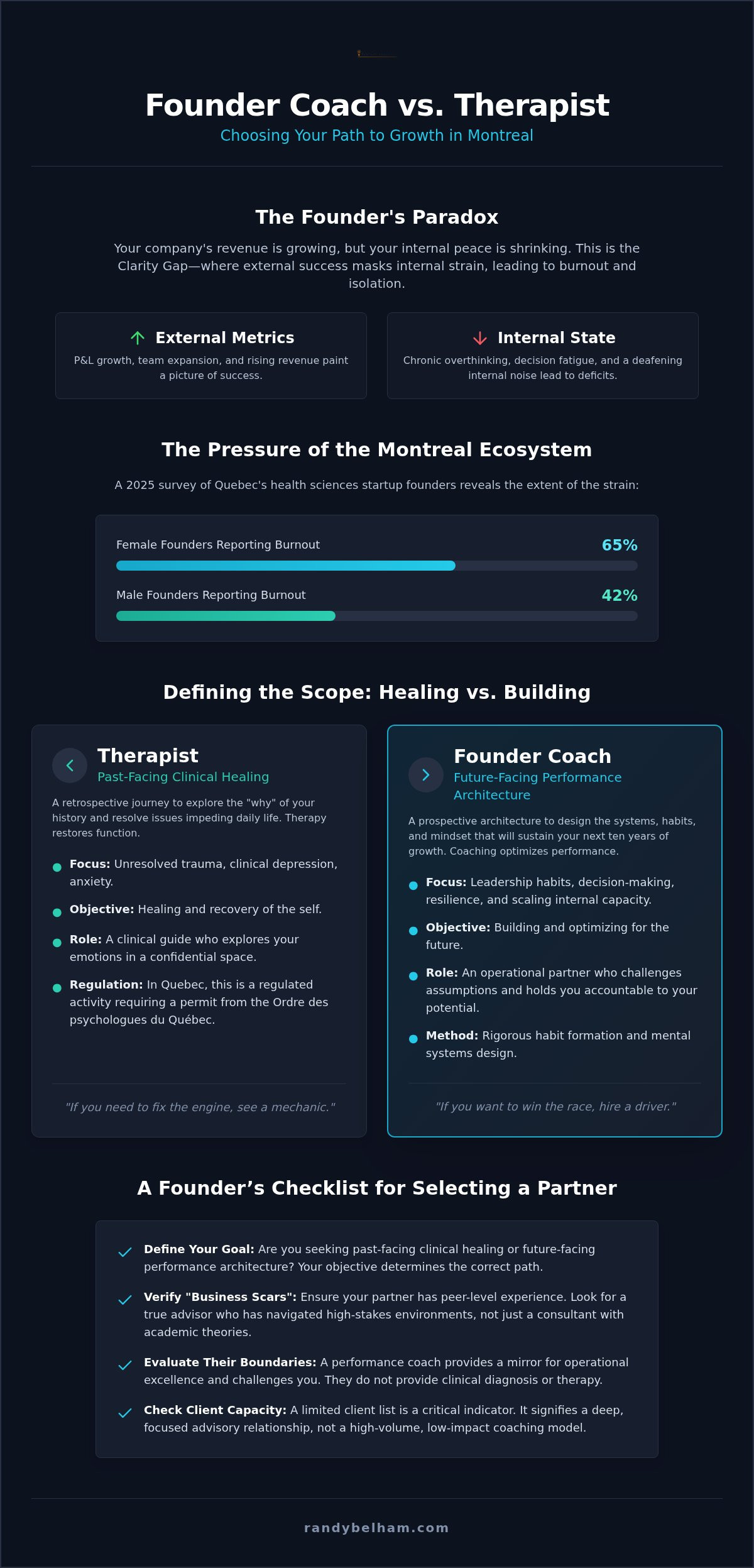
The distinction matters. Clinical distress is about pathology. The Clarity Gap is about performance. A 2025 survey of health sciences startup founders in Quebec found that 65% of women and 42% of men reported burnout. These are not just numbers. They are signs of a system under too much load. You confuse burnout with a need for therapy because the exhaustion feels the same. One requires a recovery of the self. The other requires a redesign of leadership. Understanding the choice between a founder coach vs therapist montreal is the first step toward sustainable success.
The Isolation of the Montreal Executive
Montreal is a tight-knit ecosystem. It's supportive. It's also a pressure cooker. Everyone knows your cap table. Everyone watches your hires. This creates an environment where "toughing it out" becomes the default strategy. It is a failing one. In high-growth markets, silence is expensive. You need a local, confidential peer who understands the specific nuances of the Quebec landscape. This isn't about networking. It's about finding Founder Clarity and Direction in a sea of noise. You must realize that isolation is a choice, not a requirement of the role.
When the Boardroom Becomes a Burden
Every boardroom session feels like a performance. You've scaled your operations. You haven't scaled your perspective. When your mental infrastructure is under-scaled, every email feels like a threat. Traditional executive coaching often misses the psychological depth required for this transition. It focuses on KPIs and management tactics. It ignores the "inner game" of presence. You don't need another consultant to tell you how to organize your calendar. You need to move from reactive fire-fighting to leading with a calm, disciplined composure. This is the work of performance architecture. It's about building the internal capacity to hold the weight of your success.
Founder Coach vs. Therapist: Defining the Scope of Work
The past is a weight. The future is a blueprint. Therapy is often a retrospective journey. It explores the "why" of your history to resolve the "how" of your present. Coaching is a prospective architecture. It designs the systems that will sustain your next ten years of growth. When choosing between a founder coach vs therapist montreal, you are choosing between healing and building. One looks for the source of the leak; the other strengthens the hull for the storm ahead.
A therapist provides a container for clinical healing. A coach provides a mirror for operational excellence. In the Montreal business context, this distinction is often blurred by the sheer exhaustion of the role. However, the mechanics of each practice are fundamentally different. One restores. The other optimizes. A coach is an operational partner who challenges your assumptions. A therapist is a clinical guide who explores your emotions.
The Clinical Boundary
In Quebec, psychotherapy is a regulated activity. Practitioners must hold a permit from the Ordre des psychologues du Québec. You should seek a therapist if you are dealing with unresolved trauma, clinical depression, or pervasive anxiety that impedes daily life. Therapy is the restoration of function; coaching is the optimization of performance. If your struggle is rooted in the past, a clinical environment is necessary. The question of founder coach vs therapist montreal is about your objective. If you need to fix the engine, see a mechanic. If you want to win the race, hire a driver.
The Performance Architecture
An entrepreneur coach in Montreal acts as an objective lens for your decision-making. They don't just listen. They challenge the structural integrity of your leadership habits. This is where founder performance coaching becomes essential. It focuses on the "inner game." It builds the resilience required for scaling through rigorous habit formation and mental systems. This process is not about "fixing" you. It is about architecting a version of yourself that can hold the weight of a growing organization.
Accountability is the differentiator. A therapist holds space for your feelings. A coach holds you to your potential. They act as a peer-level anchor, ensuring your internal state matches your external ambitions. This is a partnership for those who have moved beyond the need for validation and require a disciplined composure in the storm of business. If you find your vision is clear but your execution is clouded by mental noise, exploring a 1:1 private coaching engagement may provide the structural support you need.
The Clarity Gap: Why Business Metrics Alone Are Not Enough
Your dashboard is green. Your sleep is non-existent. The revenue targets were met. The cost was your presence. This is the Clarity Gap. It's the distance between your high-level vision and the friction of your daily execution. You have the external markers of success, but the internal experience is one of constant noise. This gap is where most founders lose their edge.
P&L statements are lagging indicators. They measure what has already happened. They do not reflect the leader’s internal state or the mental load of a scaling company. If you find yourself paralyzed by the weight of the next move, you are likely looking for a founder coach vs therapist montreal to help navigate the noise. You don't need a diagnosis; you need a way to close the distance between where you are and where you need to lead from.
Mental noise is the enemy of culture. When you can't stop overthinking business decisions, your team feels the vibration of your anxiety. They start to move tentatively. Speed dies. Indecision at the top creates a vacuum of confidence at the bottom. Clarity is the only antidote. It's about moving from a state of constant reaction to a state of structured quiet. You must build the internal capacity to hold the weight of the organization without collapsing under it.
Mindset Mastery for High Achievers
True mastery isn't about "positive thinking." Affirmations don't fix a broken system. Developing a Founder’s Mindset is about mental architecture. It's about creating systems to observe internal pressure without being governed by it. You learn to see stress as a data point, not a directive. High achievers need structure, not just encouragement. This is the "inner game" of leadership. It's the difference between being a victim of your success and being the master of it.
Decision-Making as a Disciplined Habit
Advice is cheap. Frameworks are repeatable. Montreal founders don't need more opinions; they need frameworks to build the emotional intelligence required for high-stakes choices. In the volatility of the market, you need a "Calm Anchor." This is a peer-level presence that remains steady while everything else is in motion. Decision-making is a habit you refine through discipline. It's about finding the signal in the noise and acting with a quiet, unflinching confidence that your team can follow.
Selecting Your Partner: A Founder’s Checklist for Montreal
The decision is made. You recognize the need for support. Now you must vet the person. Choosing between a founder coach vs therapist montreal is your first filter. The second is the quality of the alliance. In a market flooded with certifications and directories, you need a partner who has survived the same storms you are currently navigating. You don't need a cheerleader. You need a peer.
Use this checklist to evaluate the structural integrity of a potential advisory relationship:
Verify Business Scars: Has the coach actually built and led? Academic theory fails in a crisis. You need someone with decades of operational experience who understands the weight of a payroll.
Assess the Roster: Do they have 50 clients or 10? High-volume coaching is a commodity. Restricted capacity is a metric of depth.
Test for Grit: Will they challenge your assumptions? If a coach only agrees with you, they are a high-priced echo chamber. A true anchor tells the truth, even when it's uncomfortable.
Check for Local Presence: Digital tools are efficient. In-person advisory in Montreal is transformative. Real presence creates a different level of psychological safety.
Evaluate the Methodology: Is there a system or just a conversation? Look for frameworks like ClearSight that provide a map for your internal architecture.
Red Flags in Montreal Coaching Bios
Avoid the "General Career Coach." They are trained for the middle management climb. They focus on resumes and corporate politics. You are a founder. Your needs are different. You require a specialist who understands entrepreneur mental resilience and the specific isolation of the CEO role. Directory-style coaching platforms prioritize volume over vetting. They offer quotes in minutes but lack the depth required for high-growth leadership.
The Value of the Exclusive Roster
Depth requires space. A coach who limits their practice to ten clients is making a strategic choice for quality. This ensures you are a priority, not just a session in a crowded calendar. It allows for a level of focused advisory that is impossible at scale. You aren't looking for a vendor; you're looking for a confidential anchor. For those facing immediate, high-stakes choices, Executive Clarity Sessions in Montreal offer a focused entry point into this level of deep work. When the stakes are this high, the choice of founder coach vs therapist montreal comes down to who can best hold the weight of your vision. If you are ready for a peer-level partnership, explore 1:1 private coaching built for the inner game of leadership.
Randy Belham Private Advisory: The Peer-Level Anchor
Success is a loud environment. Leadership is a quiet discipline. Randy Belham operates at the intersection of high-level executive authority and raw, psychological empathy. He is not a consultant providing a slide deck. He is a battle-tested expert acting as a peer to those who have already won the external game but are losing the internal one. This is where the choice between a founder coach vs therapist montreal becomes a commitment to your future architecture.
The "Ten Client Limit" is a deliberate structural choice. Most coaching models prioritize volume. They want hundreds of sessions. Randy prioritizes depth. By restricting capacity to ten private advisory spots, he ensures every founder receives a focused, high-touch experience. This isn't just about availability. It's about the mental bandwidth required to act as a "Calm Anchor" for a leader in motion. When the stakes are high, you don't need a directory; you need a dedicated partner.
The 1:1 advisory focuses on the mechanics of the mind. It addresses mindset, leadership, and the formation of sustainable habits. You've built the company. Now you must build the leader capable of holding it. This process is designed to close the Clarity Gap. It moves you away from reactive fire-fighting and toward a disciplined, meditative guide for your own organization. You stop being governed by the pressure and start governing the growth.
High-Touch Partnership for Montreal Leaders
Expect a grounded, unflinching advisor. Randy doesn't offer hype. He offers a mirror. The work involves a transition from mental noise to structured quiet. You learn to observe the pressures of the Montreal ecosystem without being consumed by them. This is often the final step for founders who have tried traditional executive coaching and found it lacked the psychological depth to handle the "inner game." It is about creating an atmosphere of professional maturity where every word is chosen for impact.
Your Initial Discovery
The process begins with an honest assessment of your current state. This is not a sales pitch. It is a vetting of the alliance. You must be ready to challenge your own assumptions and build leadership habits that survive the stress of scaling. The focus is on depth and the practicalities of the mind. If you are ready to move beyond superficial metrics and master your inner game, the first step is a conversation.
Space is limited by design. Your leadership deserves a partner who values focus as much as you do. To see if there is an opening for a new peer-level partnership, you can Enquire about Private Advisory with Randy Belham.
Architecting the Leader Behind the Vision
The choice between a founder coach vs therapist montreal is a choice between recovery and performance. One heals the history. The other designs the future. You've reached the point where external success is no longer enough to quiet the internal noise. You need mental clarity to make high-stakes decisions. You need sustainable habits that survive the pressure of scaling.
Randy Belham serves as a calm anchor in the heart of Montreal’s business community. This is a peer-level advisory. It is backed by 20 years of battle-tested coaching experience. To ensure maximum impact, the roster is exclusively limited to 10 clients. This is the final step for leaders who require depth, focus, and a disciplined composure in the storm of growth. You've scaled your operations. Now you must scale your presence.
Your leadership is the ultimate architecture. Build it with intention. Apply for Private Advisory with Randy Belham. Start the journey from mental noise toward a structured quiet. It's time to lead with clarity.
Frequently Asked Questions
What is the main difference between a founder coach and a therapist?
Therapy heals the history. Coaching architects the future. A therapist resolves internal trauma; a coach builds leadership habits for high-stakes environments. The distinction between a founder coach vs therapist montreal is about the direction of the work. One restores function. The other optimizes potential. It is the difference between clinical healing and performance architecture.
How do I know if I need a therapist or an executive coach in Montreal?
Choose based on your objective. If you struggle with clinical depression, trauma, or pathology, you need a licensed psychotherapist. If you have a clear vision but feel paralyzed by decision fatigue or noise, you need an executive coach. The question of a founder coach vs therapist montreal depends on whether you need to fix the engine or win the race.
Does Randy Belham work with clinical mental health issues?
No. Randy Belham does not provide clinical therapy or medical treatment. His advisory is strictly for performance optimization and leadership development. If a client presents with clinical mental health issues, Randy will recommend they seek a licensed professional through the Ordre des psychologues du Québec. His work begins where clinical healing ends. It focuses on the inner game of business and habit formation.
Why does Randy Belham limit his advisory to only ten clients at a time?
Restricted capacity is a metric of depth. Most coaches prioritize volume. Randy prioritizes impact. Limiting the private advisory to ten founders ensures each leader receives a peer-level, high-touch experience. It allows for the mental bandwidth required to act as a calm anchor. You aren't just another session in a calendar. You are a primary focus in a disciplined, exclusive practice.
Can coaching help with founder burnout and decision fatigue?
Yes. Performance coaching is specifically designed for these challenges. Burnout often stems from an under-scaled mental infrastructure. Decision fatigue occurs when frameworks are missing. A coach helps you build the emotional intelligence and habits needed to hold the weight of your organization. You move from reactive fire-fighting to leading with grounded, quiet confidence. This is how you close the gap between effort and result.
Is in-person coaching available in Montreal?
Yes. In-person advisory is available in the heart of the Montreal business community. Digital tools provide efficiency. Real presence creates a different level of psychological safety and focus. Meeting in the city allows for a grounded connection that is often lost on a screen. It facilitates the deep work required to navigate the specific isolation of the local entrepreneurial ecosystem.
How long does a typical private advisory engagement last?
Engagements are tailored to the complexity of the leader's situation. Deep habit formation and structural mental shifts require sustained partnership over several months. This isn't a quick fix. It is a methodical process of building internal capacity. We focus on long-term results rather than superficial wins. The goal is to create permanent, sustainable leadership habits that survive the stress of scaling.
What is the "Clarity Gap" and how does it affect my leadership?
The Clarity Gap is the distance between your high-level vision and the friction of your daily execution. Your business metrics look strong. Your internal state feels chaotic. This gap creates mental noise and slows decision-making. Closing it requires architecting a version of yourself that can hold the weight of your success. It involves moving from a state of constant reaction to one of structured quiet.


Comments