
Emotional Intelligence for Executives: The Inner Game of High-Stakes Leadership
- Randy Belham

- 6 days ago
- 11 min read
Emotional intelligence isn't about being "nice"; it's the cold, hard infrastructure of effective decision-making. You've mastered the external markets, but the internal noise persists. The boardroom is quiet; your mind is loud. For many leaders, engaging an executive emotional intelligence coach in Montreal is the first step toward silencing that static. High-stakes decisions carry a weight that follows you home, making it nearly impossible to disconnect. It's a lonely place at the centre of power.
You realize that sustainable high performance requires a different kind of toolkit. Mastering your psychological architecture allows you to lead with a grounded authority that remains steady while everything else is in motion. You don't need more strategy; you need more clarity. You need to close the gap between your public wins and your private peace.
This article examines how to navigate high-pressure environments with absolute composure. We will explore the mechanics of the inner game and how to develop the emotional weight necessary for elite leadership. It's time to move beyond the noise and reclaim your focus.
Table of Contents
The Silent Architecture of Leadership: Defining Emotional Intelligence for Executives
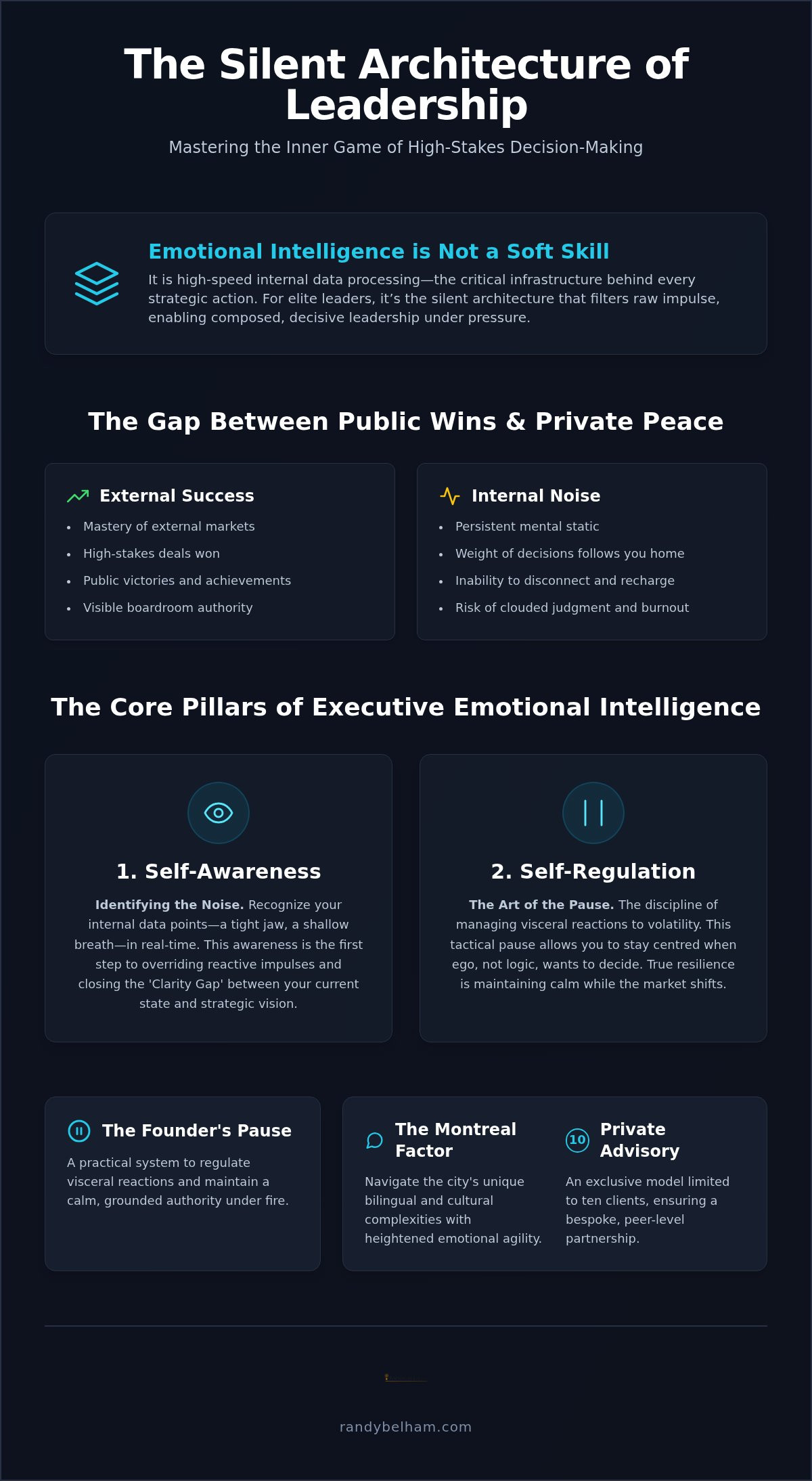
Emotional intelligence is the structural framework for high-stakes leadership survival. It is the ability to recognize, understand, and manage your own emotions under fire. Many define it as a soft skill. This is a mistake. For the high-level professional, it is high-speed internal data processing. You are processing thousands of variables in a second. What is Emotional Intelligence? At its core, it is the filter between raw impulse and strategic action. For the high-level professional seeking an executive emotional intelligence coach in Montreal, the focus shifts from managing others to mastering the self. This is the silent architecture of your authority.
Imagine a structural beam in a skyscraper. You don't see it. You only notice when it fails. EQ is that beam for your leadership. When a crisis hits, your biology reacts first. Adrenaline spikes. Vision narrows. Your heart rate climbs. EQ is the system that overrides this response. It keeps your strategic mind online when you need it most. External markets are volatile. Your internal state should not be. You lead the room; you must also lead your thoughts.
Why EQ is the 'Inner Game' of Business
The cost of low EQ is measurable. It shows up in fractured teams and clouded judgment. It leads to avoidable burnout. High-performing leaders often ignore the internal labour of maintaining composure. They focus on the balance sheet. They forget the mind. Emotional regulation directly impacts your bottom line and decision-making speed. A clear mind decides faster. A reactive mind wastes time. You win the deal. The anxiety remains. This is the inner game where the real margins are found. It is the difference between a career that thrives and one that merely survives the pressure.
The Distinction Between EQ and Generic Management
Managing people is a task. Managing yourself is a discipline. Most Montreal leaders mistake toughness for true emotional resilience. They believe grit is enough. It isn't. Resilience requires a sophisticated understanding of your nervous system. Engaging an executive emotional intelligence coach in Montreal provides the space to build this resilience. You might be interested in entrepreneur mental resilience to see why the tough founder myth is dangerous. True strength is quiet. It is the ability to stay centred while the market shifts. You don't need more energy; you need more presence. You don't need to shout to be heard. You need to be grounded to lead. This is how you organize your internal world to realize your external goals.
The Four Pillars of Executive Emotional Intelligence
High-performance leadership is not a single trait. It is a structure. This structure rests on four distinct pillars that define how you interact with the world and yourself. Understanding Why Emotional Intelligence Matters for Leaders is the first step toward stabilizing your executive presence. For those working with an executive emotional intelligence coach in Montreal, these pillars become the roadmap for development. They move you from reactive management to deliberate leadership. You win the contract. You still feel the weight. These pillars help you carry it.
Self-Awareness: Identifying the Noise
Your body speaks before your mind does. A tightening in the jaw. A shallow breath. These are data points. Recognizing these physical signals is the baseline of the founder's mindset. Without this awareness, stress dictates your choices. You lose sight of the long game. This creates the Clarity Gap. It is the distance between your current reactive state and your ultimate vision. You can explore this further through the founder clarity framework to bridge that divide. Self-awareness is the light that reveals the obstacles in your path.
Self-Regulation: The Art of the Pause
Success is visible. The internal struggle is not. You face market volatility. Your stomach knots. Self-regulation is the ability to manage that visceral reaction. It is the art of the pause. In a high-stakes board meeting, centring yourself is a tactical advantage. It allows you to realize when your ego is making the decision instead of your logic. Ego seeks to be right. Logic seeks to be effective. Building a routine that supports emotional stability ensures you remain the calm anchor when markets shift. You control the response. You don't just react to the stimulus.
Social Awareness and Presence
Montreal is unique. It is a multicultural, bilingual ecosystem. Reading the room here requires a specific type of emotional agility. You must hear what is not being said in both languages. Social awareness is about picking up on the subtle shifts in team energy. Relationship management then follows. It is leading with presence, not just authority. People don't just follow your title. They follow your composure. If you find yourself struggling to maintain this level of focus, a private advisory partnership can help you refine these pillars in a confidential setting. It is the work of a peer, not a consultant.
The Montreal Factor: Leading in a Bilingual, High-Pressure Ecosystem
Montreal is a city of dualities. It is a place where the hyper-growth tech of the Mile End meets the deep industrial roots of Saint-Laurent. You lead here. You manage the friction. This unique business culture requires a specific type of emotional agility. It is not enough to be bilingual; you must be emotionally fluent. The language of leadership transcends the words spoken. It lives in the spaces between them. For many, an executive emotional intelligence coach in Montreal is the only way to navigate this landscape without burning out.
The bilingual divide is more than a linguistic hurdle. It is a matter of trust. EQ serves as the bridge. You realize that communication isn't just about syntax. It's about presence. Understanding the critical skills for upwardly minded managers involves mastering this internal data processing. You switch languages with ease. You struggle to switch mental states. The pressure of the city is constant. The hub is thriving. You are winning. Inside, the noise is deafening.
Cultural Nuance and Executive Presence
Leading diverse teams in Montreal means balancing tradition with innovation. The city values both. In collaborative sectors like AI and life sciences, empathy is a technical requirement. It is not a luxury. You must organize your leadership style to match this social fabric. You don't just direct; you influence. You don't just command; you connect. This requires a level of self-regulation that few possess naturally. It is a discipline. It is the work of the inner game.
The Isolation of the Montreal Founder
The Montreal market is competitive. It is a tight ecosystem. This creates a quiet struggle for the entrepreneur. You are surrounded by peers, yet you feel isolated. The weight of decision-making is yours alone. A local advisor understands this terrain. They know the local landscape. They understand the specific pressures of the Quebec market. This is why many seek a confidential advisor for founders to navigate the burden of leadership. An executive emotional intelligence coach in Montreal acts as a peer. They are a calm anchor in a city that never stops moving. You find the silence you need to lead.
Practical Systems for Cultivating Emotional Resilience
Resilience is not a trait. It is a system. You don't find it; you build it through deliberate, repetitive practice. For the busy professional, this requires a shift from abstract concepts to operational habits. Working with an executive emotional intelligence coach in Montreal provides the external perspective needed to refine these internal systems. You've mastered the market. Now, you must master the machine that interprets it. This is the work of the inner game.
Audit your emotional triggers: Keep a 'tension log' for one week. Note when your jaw tightens or your breath shallows. Identify the catalyst. This is raw data for your mind.
Implement the 'Founder’s Pause': Stop before responding to high-stakes emails. Breathe for sixty seconds. Let the reactive surge pass. Realize that speed is often the enemy of clarity.
Establish a morning routine: Prioritize mental clarity over digital noise. The world wants your attention. You must protect it.
Schedule regular 'Clarity Sessions': Realign with your primary vision once a week. The noise of the day can wait. Focus on the long game.
Daily Habits for the Unflinching Leader
Decision fatigue is a silent performance killer. Use minimalist scheduling to protect your cognitive load. Less is more. Calibrate your intuition through reflection. You've spent years building expertise. Trust it. If you find yourself stuck in a loop of doubt, learn how to stop overthinking business decisions. Clarity comes from action, not just analysis. You don't need more information. You need more presence.
Measuring Progress in the Inner Game
Success is not just the final exit. It is the quality of your presence during the journey. You win the deal. You still feel the anxiety. This is the gap we close. Track your 'recovery time' after a setback. How long does it take to return to centre? This is your primary metric of EQ. High-performers need a structured system to realize their full potential. They need a peer to observe the blind spots and stabilize the anchor. To begin this work, explore 1:1 Private Coaching for a tailored approach to your leadership architecture. It is time to lead with composure.
The Private Advisory Path: Elevating Your Inner Game with Randy Belham
General coaching is a commodity. It is often transactional. Private advisory is a partnership. It is a deep, unflinching exploration of the psychological architecture that supports your leadership. For a founder seeking an executive emotional intelligence coach in Montreal, the difference lies in the level of intimacy and experience. Randy Belham brings thirty years of business experience to the table. He has lived the pressure you feel. He is not a distant consultant; he is a seasoned peer who acts as a calm anchor while your industry is in motion.
This level of focus is rare. Most coaching firms prioritize volume. Randy Belham prioritizes depth. By limiting his practice to a maximum of ten private clients, he ensures that every conversation is deliberate and every insight is specific. You don't need another person telling you what to do. You need someone who understands why you feel the way you do. This is high-touch advisory for those who have moved beyond the need for external validation. You've won the game. Now you must survive the victory.
Private Advisory vs. Corporate Programs
Founders carry a weight that team members cannot see. Corporate programs often miss this nuance. They offer general strategies for team harmony. They ignore the internal noise of the person at the top. You need a peer to navigate these unique burdens. A grounded, minimalist approach to executive development strips away the jargon. It focuses on the practicalities of the mind. Starting this process begins with a confidential conversation. It is a safe space to discuss the hidden costs of your success. It is a discipline, not a workshop.
Closing the Clarity Gap
The goal is a sense of structured quiet. You move from a state of mental noise toward a sense of absolute presence. This is the core of founder performance coaching. Mastering the inner game of leadership requires a serious commitment. It is the work of a lifetime. You've achieved the external wins. Now, it is time to master the internal game. Close the gap between your vision and your current reality. Lead with clarity. Lead with composure.
Reclaim Your Internal Authority
Leadership is an endurance sport of the mind. You have the external metrics; you need the internal quiet. True authority is not loud. It is grounded. It is the ability to remain the calm anchor when the market shifts. We have explored the pillars of self-regulation and the unique pressures of our bilingual ecosystem. You realize that sustainable performance requires a different kind of toolkit. High-stakes leadership is won or lost in the split second before you react.
Engaging an executive emotional intelligence coach in Montreal is the first step toward closing the Clarity Gap. Randy Belham is the city's premier advisor for high-growth founders. He brings 30 years of unflinching business experience to every conversation. To maintain a deep, personalized focus, his private advisory is strictly limited to ten clients. This exclusivity ensures that your inner game receives the attention it requires.
You have built the empire. Now, build the resilience to lead it with absolute composure. Apply for Private Advisory with Randy Belham. Your next level of leadership begins with a single, quiet choice.
Frequently Asked Questions
What is the difference between emotional intelligence and being a 'soft' leader?
Emotional intelligence is high-speed internal data processing, not a personality trait. Soft leadership often involves avoiding conflict to preserve harmony. High-EQ leadership involves managing conflict with precision and composure. You don't avoid the fire; you walk through it with a clear mind. It is the structural framework that allows you to lead the room without letting the room lead you.
Can emotional intelligence actually be taught to executives?
EQ is a neurobiological discipline that can be refined through deliberate practice. It is not a lecture; it is a rewiring of your nervous system. You learn to identify the physical signals of stress before they dictate your choices. Most high-performers possess the raw capacity but lack the structured system to harness it. With focus, you can move from reactive impulse to strategic action.
How does EQ impact the ROI of a company in Montreal?
Engaging an executive emotional intelligence coach in Montreal directly impacts your bottom line through faster decision-making and lower turnover. A leader who lacks composure creates a culture of anxiety. Anxiety is expensive. It clouds judgment and slows down operations. In a city where trust is a primary currency, your ability to remain a calm anchor is a measurable competitive advantage.
Why do founders specifically struggle with emotional regulation?
Founders live in a state of constant isolation. The stakes are personal. Every market shift feels like a threat to your identity. This intensity triggers a survival response that shuts down the strategic mind. You win the contract; you still feel the weight. Without a peer to help regulate this pressure, the noise becomes deafening. It's not a lack of grit. It's a lack of space.
How long does it take to see results from EQ coaching?
You will notice immediate shifts in your awareness within the first few sessions. Structural change in your leadership style typically takes several months of consistent work. This is not a quick fix. It is a fundamental realignment of your psychological architecture. You realize that the goal isn't to stop the waves; it's to learn how to stay steady while they crash.
Is executive coaching in Montreal available for bilingual teams?
Yes, an executive emotional intelligence coach in Montreal must understand the bilingual and multicultural nature of our local ecosystem. Communication is about more than syntax. It is about emotional fluency across cultures. Navigating the bilingual divide requires a high level of social awareness. You must hear what is not being said in both languages to build true trust and alignment.
What is the first step in improving my emotional intelligence as a CEO?
The first step is radical self-observation. Start by keeping a tension log for one week. Note exactly when your jaw tightens or your breath shallows during the day. Identify the catalyst for that reaction. You cannot manage what you do not see. This simple audit provides the raw data needed to begin closing the Clarity Gap and reclaiming your focus.
How does Randy Belham’s private advisory differ from traditional executive coaching?
Randy Belham provides a peer-level partnership, not a commodity service. Traditional coaching is often transactional and high-volume. Randy limits his practice to only ten private clients to ensure deep, personalized focus. He brings 30 years of business experience to the table. He is a battle-tested advisor who understands the hidden burdens of leadership. You get a calm anchor, not a consultant.


Comments