
The Confidential Advisor for Founders: Navigating the Weight of Leadership

Updated: Jul 20
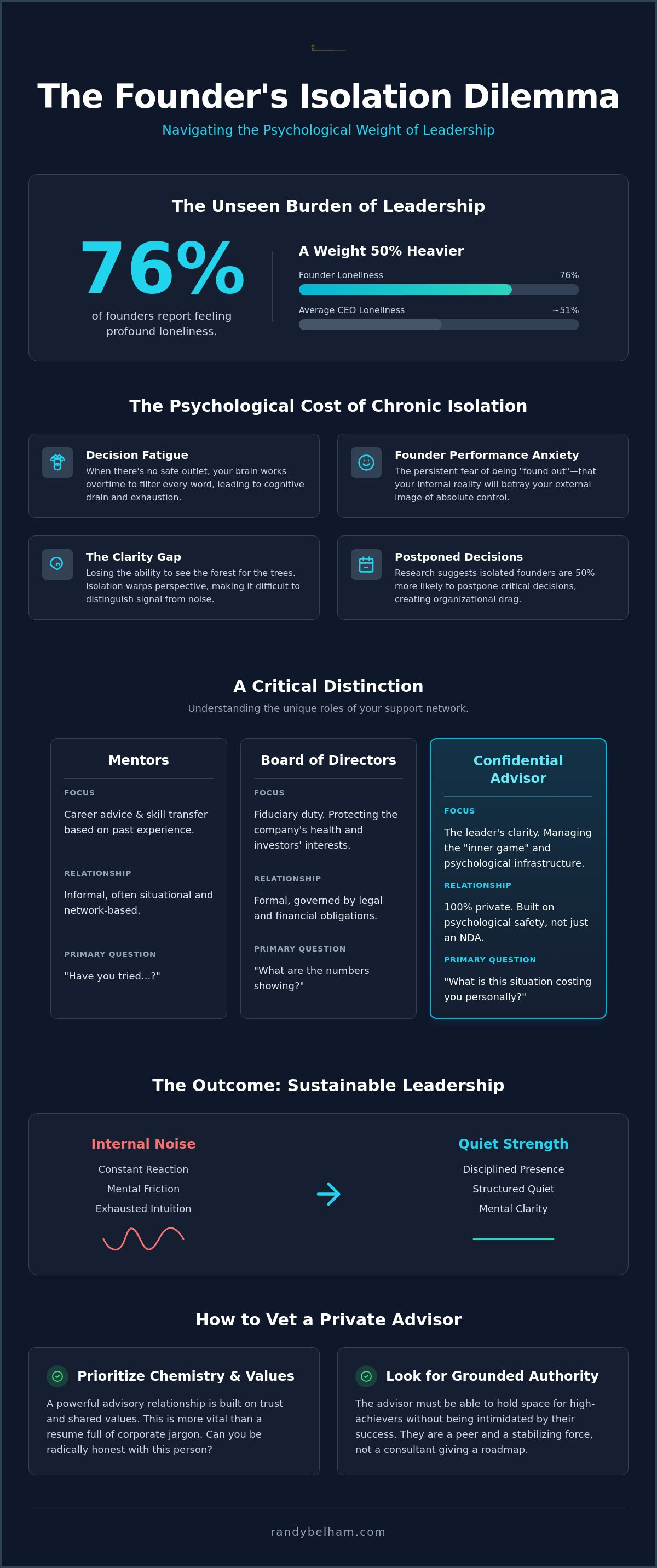
Seventy-six percent of founders report feeling profound loneliness. It's a staggering figure. That's fifty percent higher than the average CEO. You've built the vision. You've scaled the team. To the board, you're the engine. To your family, you're the provider. Yet, the internal noise is often deafening. Decision fatigue settles in. You can't show a single crack in the armour. Investors demand certainty. Employees crave strength. There's simply nowhere to put the weight down.
You likely realize that carrying this burden alone isn't sustainable. This is why the most resilient leaders engage a confidential advisor for founders. It's not about operational consulting. It's about your internal infrastructure. You need a safe harbour for unfiltered thoughts and raw vulnerability. Discover how this partnership creates the mental clarity required for high performance. We will examine how a dedicated advisor helps you navigate the psychological isolation of the C-suite and turn internal pressure into quiet, disciplined strength.
Table of Contents
The Hidden Weight of Leadership: Why Founder Isolation Support is Critical
Leadership is often portrayed as a series of bold moves and public victories. In reality, it's a series of silent burdens. The "lonely at the top" phenomenon isn't a cliché; it's a structural reality. You're the final word. The buck stops with you. This creates a vacuum where there's no one to lean on when the floor feels shaky. External success often masks internal exhaustion. The pitch was perfect. The funding landed. But at 2 AM, the ceiling looks the same.
You face what many call the Boardroom Paradox. You cannot be fully honest with your investors. Their interest is fiduciary; your vulnerability is a perceived risk. You cannot be fully honest with your team. They need your certainty to stay motivated. This leaves you with nowhere to put the weight down. Without a confidential advisor for founders, this isolation begins to warp your perspective. You start making decisions in a silo, and that's when the most dangerous mistakes happen. Research suggests that isolated founders are 50% more likely to postpone critical decisions, creating a drag on the entire organization.
The Performance Trap: Why Founders Stop Being Honest
You wear the mask of the visionary because you feel you have to. It's a survival mechanism. Every interaction becomes a performance where you must project absolute control. You fear that showing a single crack will tank your valuation or cause your best talent to churn. This leads to Founder Performance Anxiety. It's the persistent fear that your internal reality will eventually betray your external image. This anxiety is a significant barrier to growth. It forces you to stop being curious and start being defensive. You stop asking the hard questions because you're afraid of what the answers might reveal about your own capacity.
The Psychological Cost of Chronic Isolation
Chronic isolation isn't just a feeling; it's a cognitive drain. It leads directly to decision fatigue. When you have no safe harbour for unfiltered thoughts, your brain works overtime to filter every word before it's spoken. This creates a "Clarity Gap." You lose the ability to see the forest because you're too busy pretending you aren't lost in the trees. Emotional exhaustion soon follows. While business and executive coaching provides a foundation for skill-building, it often misses the raw psychological toll of the C-suite.
This is why high-level support must go deeper than operational advice. You need a space where the mask can come off without consequence. Addressing these internal pressures is the only way to achieve sustainable output. If you're looking to bridge this gap, exploring Founder Performance Coaching can help you master the internal mechanics required for long-term success. A dedicated confidential advisor for founders acts as a stabilizing force, ensuring that the weight of leadership doesn't crush the person behind the title.
What is a Confidential Advisor for Founders?
A confidential advisor for founders is a hybrid role. Part strategist. Part psychologist. Part silent partner. They don't just look at your cap table or your burn rate. They look at the person holding the pen. While consultants focus on the "what," an advisor focuses on the "how" and the "who." They provide a grounded authority. This is the ability to hold space for high-achievers without being intimidated by their success or their intensity. It's a relationship built on the "inner game," focusing on the mechanics of the mind rather than just the mechanics of the business.
In the centre of the storm, they are the calm anchor. When everything is in motion, they remain steady. This isn't about providing a generic roadmap. It's about providing the perspective needed to draw your own. They act as a peer to high-achievers rather than a distant consultant. They value depth, focus, and the internal game over superficial metrics of success. This steady presence allows you to move from a state of mental noise toward a sense of structured quiet. If you need to offload operational complexity while focusing on this inner work, consultingheads GmbH provides access to independent professionals and interim managers who can step in to lead specific projects.
Beyond the NDA: The Architecture of Trust
Trust isn't a legal document. An NDA is a baseline. It's the floor, not the ceiling. True confidentiality is about psychological safety. It's the knowledge that you can voice your "ugly" thoughts without judgment. The fear of being found out. The doubt about your own vision. The resentment toward a co-founder. These are the thoughts that usually stay locked in the dark. In a performance-driven culture, vulnerability is often seen as a liability. Here, it's a tool for growth.
When you have a safe harbour for these thoughts, radical self-honesty becomes possible. You stop performing for yourself. This clarity is the foundation for every high-stakes decision you make. If you are seeking this level of depth, you might consider how private advisory can stabilize your leadership. It's about creating a structure where honesty isn't just allowed; it's the primary currency for sustainable high performance.
The Advisor as a Peer, Not a Consultant
Founders don't need another subordinate. They don't need a distant consultant with a deck of templates. They need a peer. Someone who is battle-tested. Someone who understands that the stakes aren't just financial; they are personal. Consultants often arrive with pre-packaged answers. A confidential advisor for founders arrives with the right questions. They don't seek to fix your business. They seek to strengthen the leader who runs it.
The difference lies in the focus. Operational advice is about external systems. Mindset mastery is about internal systems. It's about how you process stress, how you manage ego, and how you maintain presence. Learning how to navigate these internal shifts is essential for Developing a Founder’s Mindset. It's the shift from being a passenger to being the pilot of your own mental state. It moves you from a state of constant reaction to one of intentional presence.
Mentors vs. Boards vs. Confidential Advisors: A Comparison
Founders aren't lacking for people in their orbit. You have the board. You have mentors. You have investors. Yet, none of these individuals are positioned to support your "inner game." Each role serves a specific purpose. Each role carries a specific conflict. The people around you have stakes in your company. They have opinions on your strategy. They have expectations for your exit. This creates a filtered environment where you can't be entirely honest without risk.
The board is focused on fiduciary duty. Their primary obligation is the company's health, not yours. Mentors often offer a mirror of their own past. They tell you what they did in a different market at a different time. It's helpful, but it may not be relevant to your current pressure. A confidential advisor for founders operates differently. They have no fiduciary duty to your shareholders. They have no ego in your operational choices. Their only objective is your clarity. They don't give you a map of where they've been; they help you navigate where you are now.
In complex regulatory environments, you might discover JZ Law to manage corporate structuring and legal compliance, but a confidential advisor focuses on navigating the personal pressure that such high-stakes industries create.
The Fiduciary Conflict: Why Your Board Isn’t Your Therapist
Your board members are your partners. They are also your bosses. Sharing your deepest doubts with an investor is a strategic risk. It can trigger a loss of confidence that impacts your funding or your seat. You're expected to project certainty. Investors look for ROI and growth metrics. They aren't equipped to manage your emotional exhaustion. Safe Spaces are not the same as Boardroom Transparency. One is for processing the "ugly" thoughts that lead to mistakes. The other is for reporting the results that lead to success. Mixing the two is a recipe for professional instability.
Choosing the Right Support Structure for Your Stage
Leaning on a mentor is ideal for industry-specific tactics. They can help you with a pitch deck or a hiring roadmap. But when the weight of leadership starts to affect your decision-making, you need a different level of support. In high-pressure moments, Executive Clarity Sessions provide a structured way to navigate the noise. You need to realize that different challenges require different tools. A confidential advisor for founders ensures that your internal systems are as robust as your external ones.
Most founder support systems are built on a conflict of interest. The board wants the company to win. The mentor wants their legacy to endure. The advisor is the only person in the room whose success is tied solely to your mental clarity. This lack of conflict is what makes the relationship so potent. It's the only place where you can be a human being before you're a CEO.
How to Vet and Engage a Private Advisor in Montreal
Finding a confidential advisor for founders in Montreal requires more than a background check. It requires a resonance check. You need someone who understands the unique pressure of our local ecosystem. The grit. The bilingual complexity. The specific path from a shared space in Mile End to a global scale. This relationship is intimate. It's exclusive. If the chemistry is off, the clarity will be too. You aren't looking for a cheerleader. You're looking for a peer who can hold the mirror steady while everything else is in motion.
Ask the direct questions early. "How many clients do you currently serve?" "What is your specific philosophy on failure?" If the answer involves toxic positivity or generic "hype," walk away. You need unflinching directness. You need an advisor who has moved beyond the need for external validation. They should project a grounded, quiet confidence that feels both professional and mature. This is how you ensure the engagement leads to sustainable high performance rather than just temporary relief.
The "Ten Client Rule": Why Capacity Matters
Capacity is a quality metric. Most coaches scale for volume. They manage fifty clients at a time. They forget your name by Tuesday. A true advisor limits their practice to ensure deep focus. Randy Belham maintains a strict limit of ten private clients. This isn't a marketing tactic; it's an operational necessity. High-touch, personalized attention requires space. It requires time for the advisor to think about your challenges when you aren't in the room. When capacity is low, the depth of the "inner game" work remains high.
Vetting for Emotional Intelligence and Experience
Look for the 20/30 rule. You want an advisor with 20 years of coaching experience and 30 years of business experience. This isn't just about theory. It's about skin in the game. You need a peer who has managed payroll, faced aggressive boards, and navigated the "Clarity Gap" themselves. This combination of business operational language and psychological wellness terminology is rare. It allows for a conversation that moves quickly from observation to insight without unnecessary filler. If you're ready to find that balance, explore working with an Executive Coach for Entrepreneurs Montreal.
Structure the engagement for maximum impact. Define the boundaries of the safe harbour. Set a cadence that allows for both reflection and action. This isn't a casual coffee; it's a disciplined investment in your mental infrastructure. If you value depth over volume and are ready to address the hidden burdens of leadership, you can secure one of the ten private advisory spots to begin your transition toward intentional presence.
Sustainable Leadership: The Outcome of Private Advisory
Leadership isn't about speed. It's about direction. Most founders live in a state of constant reaction. The inbox dictates the day. The fire drill dictates the week. This is reactionary leadership. It's exhausting. It leads directly to the 54 percent burnout rate reported by startup founders in 2025. A confidential advisor for founders helps you break this cycle. You move from being a passenger in your own schedule to having an intentional presence. You stop chasing the noise and start leading the signal.
Clarity is the byproduct of this partnership. When the mental noise subsides, better habits form. You stop making decisions based on fear or fatigue. You start making them based on vision. This isn't just about feeling better. It's about performing better. The "Inner Game" is the ultimate competitive advantage. If you can remain steady while your competitors are panicking, you've already won. Sustainable high performance is not a lucky break; it's a deliberate choice to prioritize your mental infrastructure.
Closing the Clarity Gap
Honest reflection requires a vacuum. It requires a space where no one is waiting for a "right" answer. In this silence, the Clarity Gap begins to close. You stop filtering your own thoughts. You start seeing the structural flaws in your strategy that you were too tired to notice before. This depth of vision is what separates a manager from a true leader. Intentional silence improves executive presence. It allows you to speak from a place of conviction rather than desperation. Your team feels the difference. Your board feels the difference. Most importantly, you feel the difference.
The Path to Empowered Leadership
The journey starts with isolation. It ends with grounded leadership. You move from the "lonely at the top" trap to a state of supported high performance. This transition is built on Entrepreneur Mental Resilience. It's about dismantling the myth of the "tough founder" who needs no help. Real strength is the ability to recognize when your internal systems need an upgrade. It's the realization that 87 percent of founders struggle with their mental health, and the most successful ones are those who address it head-on.
This commitment to wellness frequently extends to the family, as the pressures of leadership can impact the entire household. For those in the province, Thrive Teen Therapy Alberta offers specialized support for children and teenagers to ensure the next generation is equally resilient.
For women in these roles, Female Focused Therapy provides a dedicated space for psychotherapy and counseling, ensuring that the unique pressures of being a female founder are addressed with specialized care.
Sustainable leadership is the goal. It's the ability to lead for a decade, not just a sprint. You've built the company. Now, build the leader who can sustain it. This requires a safe harbour for unfiltered thoughts and a partner who understands the stakes. If you are ready for this level of depth and exclusivity, you can Apply for Private Advisory with Randy Belham. There are only ten spots available for those ready to master their inner game. Secure your clarity today.
Master Your Inner Game
The weight of leadership doesn't disappear. You simply learn how to carry it. Isolation is a structural reality of the C-suite. You've navigated boardroom politics and market shifts. Now, it's time to navigate the internal noise. Engaging a confidential advisor for founders is a strategic investment in your mental infrastructure. It's about moving from constant reaction to a state of disciplined, intentional presence. You deserve a space where the mask can come off without consequence.
Based in Montreal and serving leaders globally, Randy Belham brings over 20 years of coaching experience to this partnership. The practice is strictly limited to ten private clients to ensure maximum depth and focus. It's time to close the clarity gap and build a sustainable path forward. Apply for one of ten private advisory spots with Randy Belham. Your next level of leadership starts with a single, unfiltered conversation. Step out of the isolation and into a safe harbour built for the person behind the title.
Frequently Asked Questions
What exactly does a confidential advisor for founders do?
A confidential advisor for founders provides a safe harbour for unfiltered thoughts and strategic mindset support. They act as a silent partner. Unlike operational consultants who focus on your cap table, an advisor focuses on your internal infrastructure. They help you process the psychological isolation of leadership. This partnership allows you to navigate high-stakes decisions without the pressure of performing for a board or a team.
How is a confidential advisor different from an executive coach?
Executive coaching typically focuses on skill-building and leadership tactics. It's often performance-driven. A confidential advisor goes deeper into psychological safety and the "inner game." They act as a battle-tested peer rather than a distant instructor. Much like how specialized private practice coaching for therapists helps clinicians navigate their own unique business challenges, this advisory focus is on your mental clarity and emotional resilience, moving beyond generic professional development.
Is it normal for successful founders to feel isolated?
Isolation is a structural byproduct of the C-suite. It's the standard reality for most leaders. You cannot be fully honest with investors without risking their confidence. You cannot be fully honest with employees without risking their motivation. This creates a vacuum where you're always "on." Realizing that this loneliness is a common experience is the first step toward building a sustainable support system.
How do I know if I need a private advisor or just a better board?
A board has a fiduciary duty to your shareholders. Their primary focus is ROI and company health. If your challenges are about governance or capital, look to your board. If your challenges are about decision fatigue, doubt, or the "Clarity Gap," you need a private advisor. You need a space where your growth is the only objective, free from investor interests.
Do I need a legal NDA before talking to a private advisor?
An NDA is a baseline requirement for any professional advisory. It's the floor, not the ceiling. Most advisors will provide a legal framework for confidentiality as part of their standard contract. However, real trust is built through a relationship of psychological safety. A signed document ensures legal protection, but a confidential advisor for founders ensures a space where radical honesty is actually possible.
What should I expect in the first session with a confidential advisor?
Expect a resonance check. The first session is designed to identify your specific "Clarity Gap" and see if the chemistry is right. You'll discuss the internal pressures you're currently facing. It's a direct, unflinching conversation. There is no hype or empty validation. The goal is to determine if the advisor can act as your calm anchor during high-stakes moments.
How much time does a private advisory engagement typically require?
Engagement requires a disciplined commitment to your mental infrastructure. It's not a casual coffee. Most high-touch advisory relationships involve regular sessions, such as bi-weekly or monthly deep dives. The goal is to create a consistent cadence of reflection. This allows you to step away from the noise and return to your role with intentional presence.
Can a confidential advisor help with co-founder conflict?
Conflict is often a result of filtered communication and high stress. An advisor provides the objectivity needed to navigate these tensions. They don't take sides. Instead, they help you process the emotional noise so you can make clear decisions. They act as a steady presence while you resolve the structural or personal issues that are impacting the organization's growth.


Comments