
Setting Boundaries as a Founder: An Emotional Intelligence Framework for 2026
- Randy Belham

- Aug 5
- 7 min read
Your business doesn't need more of your hours. It needs your clarity. Many leaders believe that constant availability is the price of growth. It isn't. It is the cost of a slow decline. Setting boundaries as a founder is often viewed as an act of withdrawal. In reality, it's a strategic investment in your highest-level decision-making. You feel the constant mental noise. You feel the weight of every 'no' you haven't said. Your personal worth has become fused with your business uptime. It's exhausting.
You likely realize that your current pace is unsustainable. The guilt of stepping away is real. The fear of missing a critical moment is louder. I understand that tension. This article will show you how to protect your mental performance and scale your impact by mastering the internal mechanics of your own limits. We will explore an emotional intelligence framework designed for the complexities of 2026, helping you bridge the Clarity Gap and move from a state of reactive noise toward a model of Empowered Leadership.
Table of Contents
The Founder Identity Trap: Why Boundaries Feel Like Failure
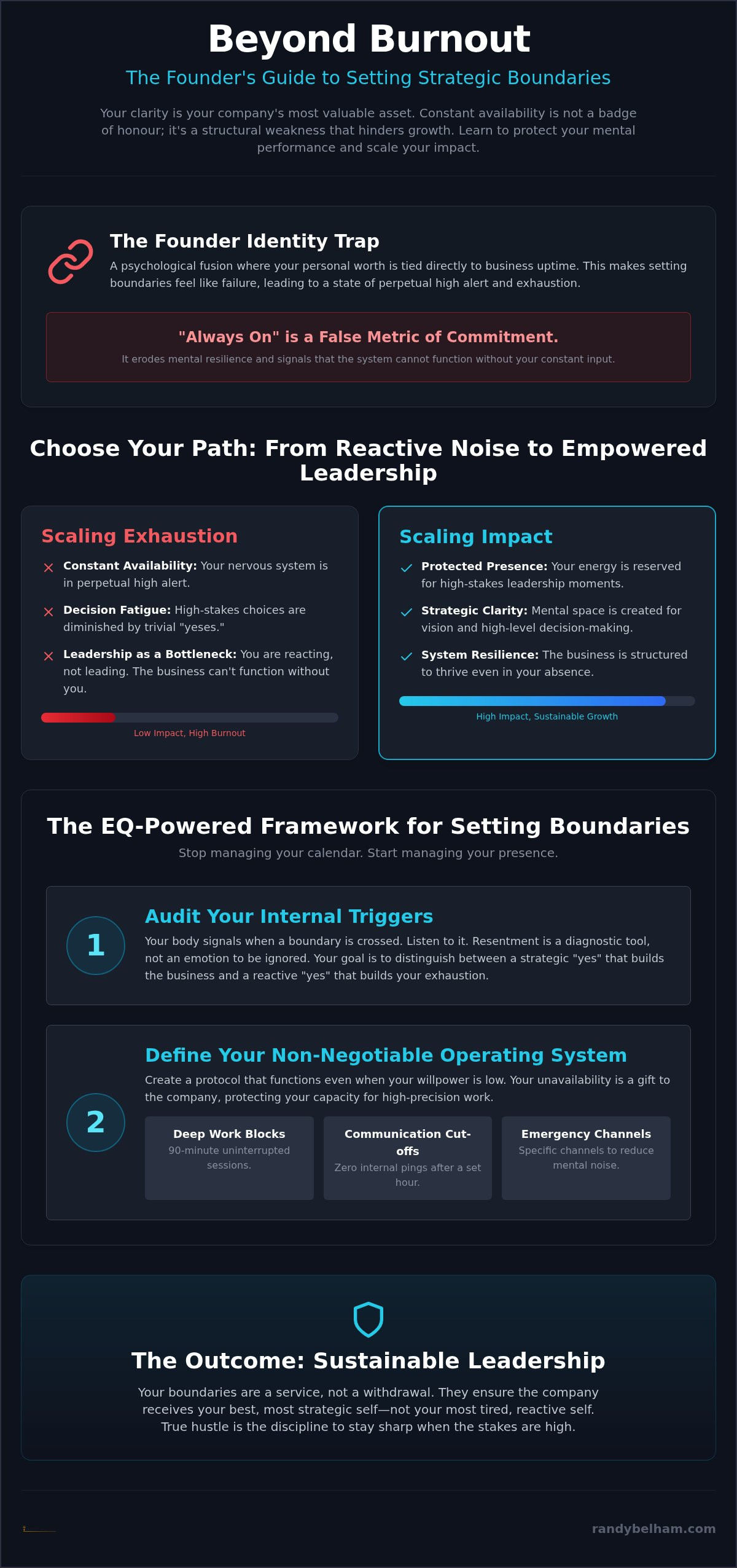
Your startup is an extension of yourself. When the business is awake, you feel you must be awake. If it pauses, you feel like you're failing. This is the identity trap. It is a psychological fusion where personal worth is tied directly to business uptime. Many leaders wear "always available" as a badge of honour. It's actually a structural weakness. It signals that the system cannot function without your constant pulse.
This fusion makes the act of setting boundaries as a founder feel like betrayal. You worry that saying no to a late-night Slack message means you've lost your edge. It doesn't. Constant accessibility is a false metric of commitment. It erodes entrepreneur mental resilience by keeping your nervous system in a state of perpetual high alert. You see the external success. The revenue grows. Inside, the reality is a visceral, quiet exhaustion. You have the title, but you've lost the clarity.
Scaling Exhaustion vs. Scaling Impact
Lack of boundaries creates a bottleneck. If every decision requires your eyes, you aren't leading; you're reacting. This leads to profound decision fatigue. Your ability to make high-stakes choices diminishes with every trivial "yes" you give away. To scale your impact, you must scale your absence. Impact is not measured by hours logged. It is measured by the quality of your presence during the hours that matter most.
The Need for Founder Emotional Intelligence Training
Setting boundaries as a founder is an internal game. It requires a high level of EQ to recognize the specific triggers that make you cross your own lines. You might say yes because you fear being perceived as "unapproachable." Or perhaps you step in because you don't trust the team to handle the pressure. Training yourself to be the calm anchor means realizing that your stillness is a service to the company. When you manage your internal mechanics, you protect the business from your own burnout.
Strengthening Your EQ: A Step-by-Step Guide to Setting Hard Boundaries
Stop managing your calendar. Start managing your presence. Time is a finite resource, but energy is a renewable asset. If you are physically present in a meeting but mentally depleted, you are not leading. Setting boundaries as a founder is not about working less. It is about working with higher precision. You want to be the visionary. You feel like a firefighter. This shift requires a high level of emotional intelligence to realize that your unavailability is often your greatest gift to the company.
The most common objection is that boundaries signal a lack of hustle. This is a myth. True hustle is the discipline to stay sharp when the stakes are high. Burnout is not a badge of honour; it is a failure of system design. Through founder performance coaching, the focus moves away from "doing more" and toward protecting the inner game. Elite performance requires periods of total disconnection.
Step 1: Audit Your Internal Triggers
Listen to your body. Resentment is a diagnostic tool. It usually surfaces when a boundary has been crossed without your consent. Notice the tightness in your chest when a notification arrives during dinner. That is your EQ signaling a breach. You must distinguish between a "strategic yes" and a "reactive yes." A strategic choice aligns with your long-term vision. A reactive choice is merely a plea for temporary peace. One builds the business. The other builds your exhaustion.
Step 2: Define Your Non-Negotiable Operating System
You need a protocol that functions when your willpower is low. Establish hard stops for deep work and cognitive recovery. These are periods of absolute radio silence. Without these filters, you will fall into the trap of decision fatigue. You can learn how to stop overthinking business decisions by creating the mental space required for your intuition to function. Consider these protocols:
Ninety-minute blocks for uninterrupted deep work.
Zero internal communication after a set evening hour.
Specific "emergency-only" channels to reduce general mental noise.
If you find these shifts difficult to maintain, my 1:1 Private Coaching provides the external structure needed to anchor these internal changes.
Sustainable Leadership Structures: Protecting Your Clarity and Presence
Boundaries are not a withdrawal. They are a service. You provide the vision. You provide the direction. If you are exhausted, the vision is blurred. Setting boundaries as a founder ensures the company receives your best self, not your most tired self. It is about building a structure that outlasts your daily involvement. This is the foundation of Empowered Leadership. You lead the system. You don't let the system lead you.
Maintaining these filters alone is difficult. The gravitational pull of old habits is strong. Working with an executive coach for entrepreneurs provides the external perspective needed to hold the line. You need a confidential advisor. Someone who understands the hidden burdens. Someone who sees the Clarity Gap before you fall into it. It's about having a peer who values your depth over your productivity metrics.
Implementing the ClearSight Framework
Reset your filters. The ClearSight framework uses structured sessions to evaluate your current operating system. It identifies where your boundaries have softened. You realize the noise has returned. You recalibrate. Peer accountability among a select group of high-achievers ensures you don't drift back into reactive patterns. It is about disciplined composure. These sessions act as a mental clearing. You leave with a sense of structured quiet.
The Montreal Founder’s Advantage
Montreal has a specific rhythm. The startup ecosystem here is vibrant but demanding. There are unique cultural expectations around accessibility and networking that can make setting boundaries as a founder feel isolated. You need a local support system that values sustainable high performance over performative busywork. We build structures that respect your personal time while fueling business growth. We navigate the local pressures together.
In 2026, noise will be everywhere. Attention will be the rarest commodity. Clarity is the ultimate competitive advantage. Protect it. Your business depends on your ability to see what others miss. That sight only exists in the space you create for yourself.
Reclaiming Your Leadership Presence
The noise of 2026 will only get louder. Your ability to filter it defines your impact. By breaking the identity trap and auditing your internal triggers, you move from a state of reactive exhaustion toward a model of disciplined composure. Setting boundaries as a founder is the only way to ensure your vision remains sharp in a world designed to distract you. You've built the business. Now, you must build the structure that protects the person running it.
This transition is personal. It requires an unflinching look at your inner game. As a Montreal-based executive authority, I help high-achievers navigate these shifts with precision. My work is focused on the mechanics of the mind and the practicalities of high-pressure leadership. My advisory is exclusively limited to ten private clients to ensure deep, focused impact. If you are ready to bridge the Clarity Gap and lead with a sense of structured quiet, we should speak.
Secure one of the ten private advisory spots with Randy Belham
Your clarity is your most valuable asset. It's time to treat it that way. You don't have to navigate the inner game alone.
Frequently Asked Questions
How do I set boundaries with a co-founder without damaging the relationship?
Frame the conversation around the shared health of the business. Setting boundaries as a founder within a partnership requires radical transparency about your cognitive limits. Explain that your unavailability during specific blocks is a tool to ensure you bring maximum clarity to your joint decisions. It isn't a withdrawal from the relationship. It's a commitment to the mission's longevity.
Will setting boundaries make me look less committed to my investors?
Professional boundaries signal maturity to sophisticated investors. They want a leader who can sustain high performance over years, not months. A founder who is always available is a founder who is likely reactive. Protecting your mental space demonstrates that you prioritize high-stakes decision-making over performative busywork. It transforms you into the calm anchor they expect.
What are the first signs that a founder’s boundaries are failing?
Resentment is the first diagnostic signal. If you feel a flash of irritation when a team member asks for your time, your filters have likely thinned. Setting boundaries as a founder often starts with recognizing these visceral reactions. You might also notice you've become a bottleneck. These are clear indicators of the Clarity Gap. Your internal mechanics are struggling to keep the noise out.
How does emotional intelligence training help with saying no to clients?
EQ training identifies the specific internal triggers that make you feel obligated to say yes. You learn to recognize the physical sensation of a reactive response before you speak. This awareness allows you to pause. You move from a place of fear-based compliance to a state of Empowered Leadership. You say no to the client to say yes to the strategy.



Comments