
High Stakes Decision Making for Founders: Navigating the Weight of Leadership
- Randy Belham

- Jul 30
- 11 min read
The weight of the final word is not a burden of logic. It is a burden of isolation. You sit at the centre of a storm where every choice carries the potential for exponential growth or absolute collapse. For many, high stakes decision making for founders becomes a cycle of analysis paralysis and late-night rumination. You have the external success. You lack the internal quiet.
It is exhausting to feel like every micro-choice drains the battery you need for the big ones. You realize that more data rarely leads to more certainty. This article will help you master the psychological and strategic frameworks required to make definitive, high-pressure choices without the burden of overthinking. We will explore how to build a repeatable framework for pressure, allowing you to regulate your emotions and move from deciding to acting with a sense of grounded authority.
Table of Contents
The Silent Burden: Why Decision Making for CEOs Feels Different
Success is public. The pressure is private. For most, leadership is a title. For you, it is a constant calculation of risk. High stakes decision making for founders is defined by the irreversible. These are choices with systemic impact. One move changes the trajectory of every employee, investor, and customer. It is the difference between a minor course correction and a total change in destination.
The cognitive process of decision-making usually relies on data. But data is a rearview mirror. High-stakes choices require you to look through the windshield during a whiteout. You are dealing with the "Weight of the Chair." It is the realization that while others provide input, you provide the finality. This creates a specific gravity that few outside the role can comprehend. You are the last line of defence. There is no one above you to catch the fall.
There is a hidden cost to your day. You spend hours on micro-choices. Hiring a mid-level manager. Reviewing a marketing budget. Approving a new office layout. These small decisions erode your mental reserves. By the time a truly high-stakes choice arrives, you are operating on fumes. This is decision fatigue. It turns "problem solving"—which is technical and logical—into a struggle. High-stakes choosing is different. It is an act of will in a growth environment where no clear path exists. It requires a level of conviction that logic alone cannot provide.
Beyond the Boardroom: The Psychological Toll
Your identity is tied to the cap table. When the business wins, you feel validated. When it stalls, you feel like a fraud. This is the intersection of personal ego and professional outcomes. Imposter syndrome often complicates simple choices because you fear a single mistake will unmask you. The founder paradox is a stark reality: the more you win, the higher the cost of losing. Every milestone achieved only increases the pressure to never falter.
The Isolation of the Final Word
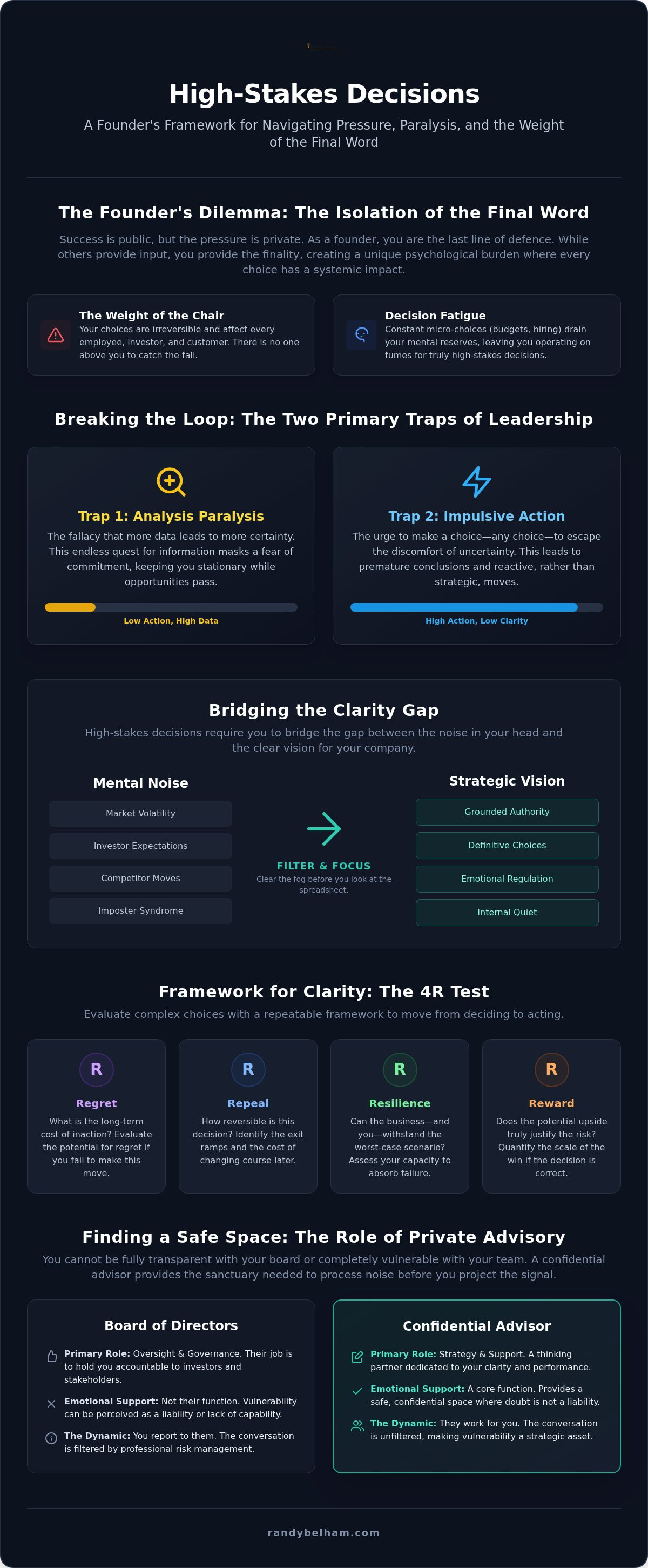
Isolation is the price of the final word. You cannot always be transparent with your board; their job is oversight, not emotional support. You cannot be fully vulnerable with your team; they need to see a steady hand. You need a space where doubt is not a liability. Finding the confidential advisor for founders provides that sanctuary. It is a place to process the noise before you project the signal to the rest of the world. In this space, vulnerability becomes a strategic asset rather than a professional risk.
The Anatomy of a High-Stakes Choice: Moving Beyond Logic
Logic is a comfort. It is also a mask. Most founders believe that if they gather enough data, the "correct" choice will reveal itself. This is a fallacy. High stakes decision making for founders is rarely about having more information. It is about how you process what you already know. The myth of the purely rational leader suggests you can strip away emotion to find a sterile, objective truth. In reality, your gut is not a distraction. It is a repository of decades of pattern recognition. When you ignore it, you lose your most potent strategic tool.
We are wired to avoid loss more than we seek gain. Loss aversion keeps you tethered to a failing strategy because the exit feels like a personal defeat. Sunk cost makes you double down on a product that should have been retired months ago. These are not just errors in judgment; they are psychological anchors. Research on How CEOs Navigate Critical Decisions shows that high-level choices are often non-linear and deeply personal. To move forward, you must first recognize the biases that keep you stationary.
Emotional intelligence acts as your primary filter. It allows you to separate the external noise—market volatility, investor expectations, competitor moves—from your internal signal. Without this filter, every choice feels equally heavy. High stakes decision making for founders requires the ability to sit in the discomfort of uncertainty without rushing to a premature conclusion. It is about disciplined composure. You are not just managing a company. You are managing your own mind.
Cognitive Load and the Clarity Gap
Mental clutter is the enemy of realization. When your cognitive load is too high, you cannot see the vision. You only see the fog. This creates the Clarity Gap. It is the distance between your current noise and your true strategic direction. To bridge it, you must clear the mental "fog of war" before you ever look at a spreadsheet. For a deep dive into this methodology, explore founder clarity and direction. Clearing the space is the work.
Emotional Intelligence as a Strategic Filter
Your body knows the stakes before your mind can articulate them. The "fight or flight" response happens in the boardroom just as easily as it does in the wild. When millions in capital or hundreds of jobs are on the line, your pulse quickens. Presence is the tool that stabilizes the room. It allows you to remain the calm anchor while everything else is in motion. If you find yourself stuck in the noise, identifying The Clarity Gap is the first step toward decisive action.
Breaking the Loop: Overcoming Analysis Paralysis and Impulsivity
Action is the only cure for anxiety. But not all action is productive. High stakes decision making for founders often collapses into two distinct traps. The first is the paralysis of "one more data point." You wait for 100% certainty in a market that only offers 60%. The second is the impulsivity of "just doing something." You act simply to relieve the internal tension of not knowing. Both are reactive. Both are dangerous.
Delay is not neutral. It carries its own set of risks. While you deliberate, the market moves. Competitors gain ground. Your team loses momentum. Overthinking is often a sophisticated form of procrastination disguised as due diligence. To break the loop, you must categorize the choice. Type 1 decisions are irreversible; they are one-way doors. These require deep reflection. Type 2 decisions are reversible; they are two-way doors. These require speed. Most founders treat every choice like a Type 1, which leads to systemic gridlock.
Strategic pauses are not hesitations. They are deliberate choices to wait for the right moment. There is a profound difference between being frozen by fear and being still by design. High stakes decision making for founders requires the discipline to distinguish between the two. You are looking for the signal in the noise. Sometimes, the signal only becomes clear when you stop trying to force it.
Why Founders Overthink
The Montreal market is volatile. Interest rates fluctuate, and venture capital is selective. In this environment, the desire for absolute certainty is a natural defence mechanism. However, perfectionism in a high-growth scaling phase is a trap. It creates a bottleneck that prevents the very growth you are trying to protect. You can learn how to stop overthinking business decisions by implementing hard time limits for Type 2 choices. If the cost of being wrong is lower than the cost of being slow, move.
The Power of the Strategic Pause
Presence lives in the space between the trigger and the response. When a crisis hits, your biology demands a reaction. A strategic pause allows you to override that instinct. Use "structured quiet" to let your subconscious organize the data you have already gathered. This is not about avoidance. It is about disengaging temporarily to gain a broader perspective. Walk away from the screen. Step out of the boardroom. Allow the realization to surface in the silence. Perspective is a luxury you must afford yourself.
Frameworks for Clarity: Tools for the Montreal Executive
Frameworks are not crutches. They are anchors. When you are in the centre of a high-pressure choice, your mind seeks the path of least resistance. You need a structural system to hold the weight of high stakes decision making for founders. These tools do not make the choice for you. They clear the noise so the realization can surface. You have the external growth. You need the internal structure.
Scenario planning involves preparing for the "unthinkable." It is not about predicting the future; it is about reducing the fear of the "unlikely." When you map out the worst-case outcomes, they lose their power to paralyze you. This pairs with the "Pre-Mortem" technique. You imagine the failure has already happened. You work backward to identify the causes. This process turns a vague anxiety into a list of manageable risks. It allows you to build a strategy that is resilient by design. It turns fear into a checklist.
Refining your "inner game" requires a Decision Journal. This is not a log of spreadsheets or market data. It is a record of your logic and emotional state at the moment of choice. Six months later, you revisit it. You will see patterns. You will realize when you were moved by fear and when you were guided by clarity. This discipline turns experience into wisdom. It is how you move from guessing to knowing. It is the practice of a professional.
Applying the 4R Test to Your Strategy
The 4R Test provides a quick, visceral check for any major move. It forces you to look beyond the immediate spreadsheet. It involves three specific lenses for the founder:
Regret: What will I regret more? Acting and failing, or failing to act and watching the opportunity pass?
Repeal: How difficult is it to undo this choice if the market data changes next quarter? Is this a one-way door?
Resilience: Does this choice strengthen the core of the business, or does it leave us vulnerable to the next storm?
Cultivating Leadership Presence Under Pressure
Deciding is only half the battle. Communicating that decision to your team requires absolute authority. You must project a sense of grounded composure even when the results are delayed. Grit is the ability to maintain that presence during the "long middle" after the choice is made. Your team does not need you to be perfect. They need you to be present. If you are struggling to find this level of focus, consider booking executive clarity sessions to sharpen your strategic perspective. Clear your mind. Then clear the path.
The Role of Private Advisory in High-Stakes Environments
The boardroom is a place of oversight. It is not a place of support. Your board of directors has a fiduciary duty to the shareholders, not to your mental well-being. This creates a functional barrier. You cannot always process your deepest uncertainties with people who are legally bound to judge your performance. High stakes decision making for founders requires a different kind of space. It requires a sanctuary where vulnerability is not a liability.
A peer-level advisor offers what a board cannot. This is someone who has seen the view from the top. Randy Belham brings 30 years of business experience and 20 years of coaching to the table. He acts as a "calm anchor" while your market is in motion. This relationship isn't about operational consulting. It is about the "inner game." It is about moving from the frantic mental noise of a crisis toward a sense of structured quiet. When the noise subsides, the path becomes clear.
In Montreal's volatile ecosystem, the depth of support matters more than the breadth of it. Randy’s model is intentionally limited to just ten private clients. This ensures a level of focus that is rare in the advisory world. It is an exclusive, high-touch environment designed for leaders who are tired of generic advice. You don't need a distant consultant. You need a peer who provides unflinching support as you navigate the weight of leadership.
Why 1:1 Support is a Strategic Asset
Integrity requires a space where you can speak the "unspeakable" truths about your business. In 1:1 advisory, you can explore the risks you aren't ready to share with your team or your spouse. You gain an external perspective that isn't tied to equity or ego. There is no hidden agenda. The only goal is your clarity. This level of founder performance coaching allows you to process the psychological weight before it turns into strategic error. You realize that your mind is your most valuable asset.
From Noise to Structured Quiet
The ultimate goal of this work is calm authority. You want to make high-stakes decisions with a steady hand and a clear eye. This journey begins by developing a founder's mindset that prioritizes presence over panic. You move from "deciding" as an act of stress to "acting" as an expression of vision. High stakes decision making for founders doesn't have to be a lonely endeavour. If you are ready to find the signal in the noise, let’s begin a private advisory conversation. Find your anchor. Reclaim your clarity.
From Mental Noise to Decisive Presence
The weight of leadership is not a problem to be solved. It is a reality to be managed. High stakes decision making for founders requires more than just spreadsheets. It requires a disciplined inner game. You must bridge the Clarity Gap. You move from the frantic impulsivity of "just doing something" to the grounded authority of structured quiet. You realize that your mind is the ultimate strategic asset.
The frameworks we explored, such as the 4R Test and the strategic pause, are essential tools. But tools alone are not enough without a safe space to process the results. You deserve a sanctuary where vulnerability is a strategic asset rather than a professional risk. Perspective is a luxury that becomes a necessity at the top.
Randy Belham provides this sanctuary for a maximum of ten leaders. With 30 years of business experience in the Montreal ecosystem, he focuses on unflinching clarity and bespoke attention. Secure one of the ten private advisory spots with Randy Belham to refine your perspective and reclaim your focus. The storm will continue. Your response to it defines the future. You have the strength to remain steady.
Frequently Asked Questions
How do I know if I'm overthinking or just being diligent?
Diligence ends when the data stops providing new insights. It is a productive search for clarity. Overthinking is the repetitive loop that follows. If you are revisiting the same facts without gaining a new perspective, you are stalled. Diligence is a process. Overthinking is a delay tactic disguised as work.
What is the OODA loop and is it still relevant for CEOs in 2026?
The OODA loop involves observing, orienting, deciding, and acting. It remains vital in 2026 because market speed is now the baseline. Most founders fail in the "Orient" phase. This is where your internal biases distort the data. Correcting your mindset is the only way to ensure the rest of the loop functions with precision.
How can I make a high-stakes decision when I only have 50% of the information?
You must accept that absolute certainty is a myth. High stakes decision making for founders often happens in the grey. Aim for "sufficient certainty," which is usually around 70% of the available data. If you only have 50%, evaluate the reversibility. If the door is a two-way street, move fast. If it is irreversible, wait for the next 20% of signal.
What should I do if I realize I made the wrong high-stakes decision?
Pivot immediately. Ego is the enemy of recovery. Acknowledge the error to yourself first, then to your stakeholders. A wrong choice is a data point, not a permanent failure. Use the "Repeal" lens to see how quickly you can exit the strategy. Fix the direction. Protect the core of the business at all costs.
How does emotional intelligence actually impact the bottom line of a decision?
Emotional intelligence reduces the cost of friction. A leader who lacks regulation during high stakes decision making for founders creates a "panic tax" for the entire organization. This leads to employee turnover and hesitant execution. Calm authority is a financial asset. It allows for faster, cleaner implementation of strategic goals.
Is it better to make a fast decision or a slow one in a crisis?
Speed depends on the expiration date of the risk. Fast is for survival; slow is for strategy. In a crisis, use a "fast-slow" approach. Act quickly to stabilize the immediate damage. Then, move slowly to solve the systemic cause. Never rush the realization of a long-term solution just to relieve temporary anxiety.
How can a private advisor help me with my decision-making process?
An advisor provides the structured quiet needed to hear your own logic. They act as a mirror without an agenda. Unlike a board, a private advisor offers a safe space for vulnerability. They help you bridge the Clarity Gap by identifying the noise that distorts your vision. It is about having a peer who understands the isolation of the final word.



Comments