
Founder Mentorship vs. Coaching in Montreal: Navigating Your Support System
- Randy Belham

- Jul 29
- 12 min read
Updated: Aug 11
Your mentor’s greatest success might be your biggest distraction. It's a quiet truth often ignored in the high-pressure Montreal market. You have the external metrics. The growth looks good on paper. Inside, the isolation is heavy. The decision fatigue is constant. You are struggling to separate your personal identity from your business metrics. External wins. Internal weight. It feels like you're always in motion, yet the clarity is missing.
It's a tension every high-achiever eventually faces. You realize that what got you here won't get you to the next level of internal peace. This guide breaks down the choice between founder mentorship vs coaching montreal to help you identify the specific support you need. You will discover whether a mentor’s map of the past or a coach’s structure for the future is your missing piece. We will examine how to move from mental noise toward a sense of structured quiet and sustainable leadership. It's time to build a support system that actually moves the needle for your business and your sanity.
Table of Contents
The Founder Support Landscape in Montreal
Montreal's tech pulse is undeniable. From the historic brick of Notman House to the glass labs in the Quartier de l'Innovation, the ecosystem is thriving. Success is loud here. It's celebrated in press releases and funding rounds. For the person at the centre, however, the struggle is often silent. You see the external growth. You feel the internal fatigue. The high-pressure Montreal market demands constant motion, yet that motion often masks a growing sense of isolation.
Going it alone is a celebrated myth in entrepreneurship. It's also a recipe for burnout. Your board of directors focuses on the EBITDA. Your team focuses on the roadmap. Neither is designed to support your mental clarity or your personal identity. This creates a dangerous support gap. When the pressure peaks, you realize your current network isn't equipped to hold the weight of your private doubts. You need a system that actually moves the needle.
The Isolation of the Montreal Executive
Growth creates distance. As your headcount increases, your peer group shrinks. You sit in a Mile End office surrounded by talent, yet you feel completely alone in your decision-making. Many local founders mistake networking for support. They trade business cards at 5 à 7 events, but they don't trade truths. This superficial connection doesn't solve the "inner game" problems that dictate your outer results. If your internal foundation is cracked, your leadership will eventually falter. True support requires a space where you can drop the executive mask and focus on the mechanics of your mind.
Mentorship vs. Coaching: The Core Distinction
Deciding between founder mentorship vs coaching montreal requires understanding the direction of the gaze. The historical definition of mentorship involves a transfer of wisdom from one who has walked the path to one who is just starting. It's about industry colour and networking shortcuts. It's the rearview mirror of leadership.
Coaching is different. It's the architecture of performance. It doesn't give you the answers; it builds your capacity to find them. While a mentor shares their past, a coach engineers your future. Consider these distinctions:
Mentorship: Focuses on the "What" and "Who." It's about advice and access.
Coaching: Focuses on the "How" and "Why." It's about habits, presence, and decision-making structures.
Mentorship provides a map of where someone else has been; coaching provides the compass for where you are going. For a Montreal founder, the right choice depends on whether you need a guide or a mirror.
Founder Mentorship: Learning from the Rearview Mirror
A mentor is a living archive. They offer the "been there, done that" wisdom that only comes from decades in the trenches. In a bilingual business centre like Montreal, this often means navigating the specific cultural and linguistic nuances of Quebec's corporate landscape. It's about shortcuts. It's about networking gold. You gain access to the rooms you haven't been invited to yet. This historical perspective is vital for those just entering the high-growth tech hubs. External expertise is plentiful. Internal clarity is rare.
The value is real. But there is a "Free" Trap. Unpaid advice can be the most expensive thing you ever accept. Because it lacks the skin in the game required for deep, objective analysis, it often remains surface-level. A mentor might give you an hour over coffee in Westmount or a quick chat at a networking event. It's helpful. But it's anecdotal. It's a snapshot of their past, not a blueprint for your future. They aren't invested in your long-term mental clarity; they are sharing a highlight reel.
When weighing founder mentorship vs coaching montreal, remember that mentorship is about building the next generation of leaders through shared experience. It's tactical. It's external. It's about the "Who" and the "What." You learn how they did it. You don't necessarily learn how you will do it.
When Mentorship is the Right Move
Mentorship excels when the hurdles are technical or relational. You need specific industry doors opened within the local ecosystem. You're navigating a first-time exit or preparing for an IPO. You need someone who has signed those specific papers before and understands the regulatory landscape. It's a sounding board for tactical business moves. If you need a map of the territory, find a mentor. They can help you organize your network and realize connections you didn't know existed.
The Limits of the Mentor Model
The risks are subtle. When comparing founder mentorship vs coaching montreal, it's clear that advice is often biased by the mentor's own history. Their success happened in a different market, with different capital constraints. You can't copy-paste their 2015 victory onto your 2026 challenge. There's also a lack of structure. Without formal accountability, sessions can drift into casual storytelling. You get the colour of their experience, but not the clarity of your own path.
If you find yourself seeking more than just stories, moving toward a high-touch private advisory model might be the necessary pivot. It's about moving from the rearview mirror to the windshield.
Founder Coaching: Engineering the Inner Game
Your product is scaling. Your internal engine is stalling. While mentorship looks at the market, coaching looks at the operator. It's a fundamental shift in focus. You're no longer just managing a roadmap; you're managing your own capacity to lead. This is the core of the founder mentorship vs coaching montreal debate. Mentorship offers a map of where others have been. Coaching offers the mental stamina to walk your own path.
The science of decision-making is about removing noise. Every day, you face a barrage of high-stakes choices. Decision fatigue is real. It's heavy. It clouds your judgment and slows your momentum. Professional coaching provides the framework to stop overthinking business decisions and return to a state of decisive action. It isn't about being told what to do. It's about building the internal structure to know what to do.
The Professional Performance Edge
Coaching is an investment in your most valuable asset. That asset is your mind. In the high-pressure Montreal market, your mental clarity is your competitive advantage. Developing entrepreneur mental resilience isn't about "toughing it out." It's about structured sessions that challenge your assumptions and sharpen your focus. Unlike the casual nature of mentorship, professional coaching is a paid, high-accountability partnership. There is skin in the game. There is a commitment to measurable internal growth.
Mindset Mastery and Habits
We often talk about the Clarity Gap. It's the space between your vision and your current reality. Closing that gap requires more than just strategy. It requires an unflinching routine that survives a crisis. Habits are the bedrock of sustainable leadership. They keep you steady when the market is in motion. It's important to realize that founder performance coaching differs from consulting because it doesn't just fix the problem; it evolves the person who solves the problem.
You don't need more advice. You need more presence. You need a support system that prioritizes your inner game so your outer results can follow. When comparing founder mentorship vs coaching montreal, the choice becomes clear when you realize that your internal state is the ultimate ceiling on your business growth.
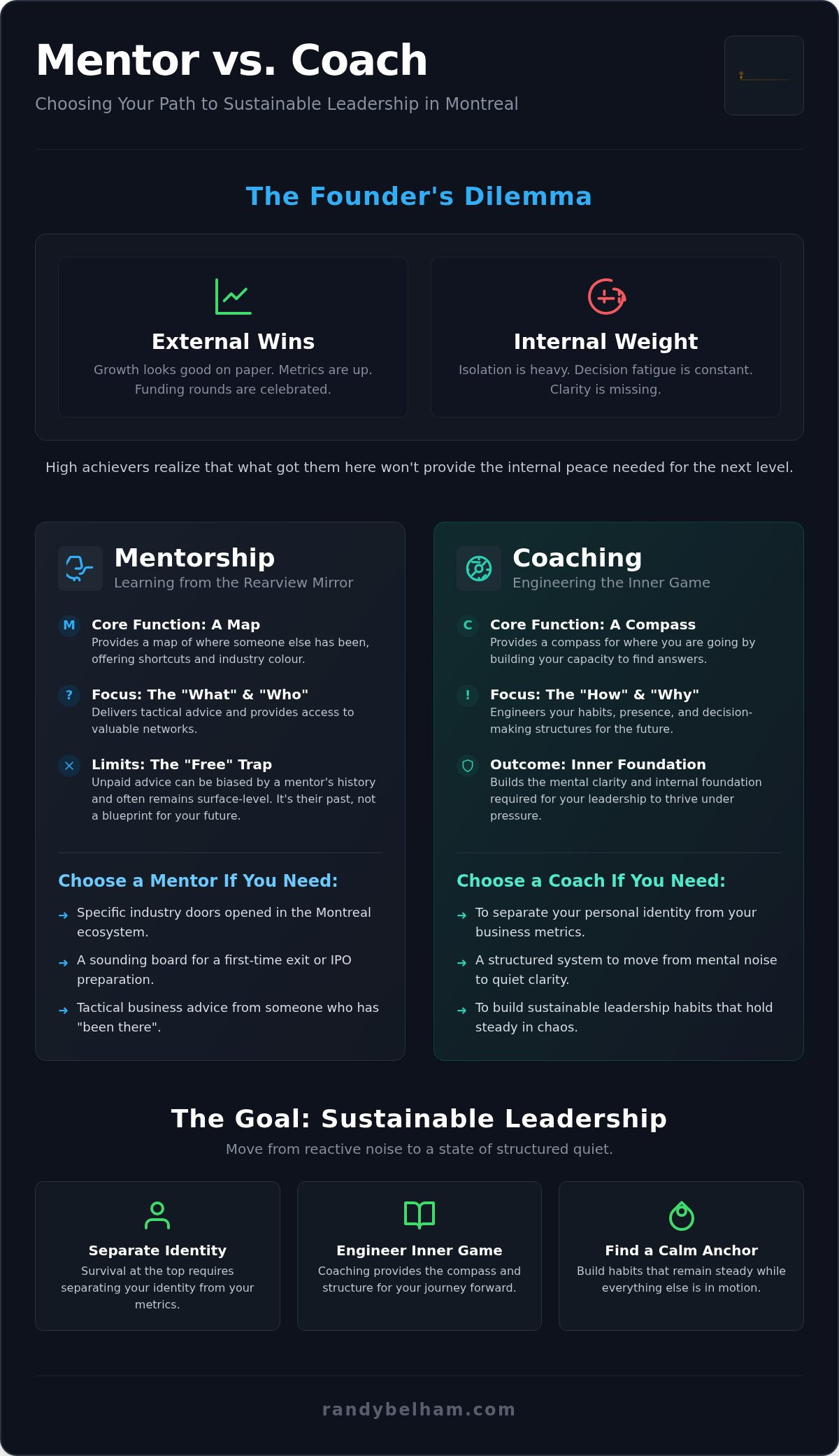
Mentorship vs. Coaching: A Comparison for Montreal Leaders
Choosing founder mentorship vs coaching montreal is a strategic pivot. It's about alignment. A mentor offers the "Who" and "What" based on their specific history. They are the voice of experience. A coach offers the "How" and "Why" based on your specific potential. They are the architect of facilitation. One provides the blueprint; the other builds the builder. External success is a loud narrative. Internal struggle is a quiet weight.
The method differs fundamentally. Mentorship relies on advice. It's a transfer of knowledge. You ask a question, and you get an answer based on what worked for them years ago. Coaching relies on inquiry. It's a process of extraction. It forces you to look at the mechanics of your own decision-making. Knowledge is helpful. Transformation is essential. One fills your head with data; the other clears your mind for action. You don't need more information. You need more presence.
A hybrid approach is possible, but it requires boundaries. You might have a mentor for industry-specific shortcuts and a coach for your inner game. However, mixing the two in a single relationship often dilutes the impact. Advice can inadvertently shut down the self-discovery required for true leadership growth. The most effective founders realize that while a mentor can open a door, a coach ensures they are ready to walk through it. Precision matters more than volume.
Framework for Choosing Your Support System
Audit your current needs. Is your problem tactical or psychological? If you need to know how to structure a Series B in the Quebec market, find a mentor. If you need to know why you're paralyzed by the decision, find a coach. Assess your time. A casual coffee is for networking. Deep-dive advisory is for performance. Use the "Clarity Test." Do you need an answer, or do you need a better question? The answer solves the day. The question solves the founder.
The Montreal Factor: Local vs. Global Perspective
Montreal has a specific grit. The city's tech scene is a unique blend of European sensibility and North American ambition. Navigating the cultural nuances of the Quartier de l'Innovation requires more than just business logic. It requires an understanding of the local landscape. A local partner understands the specific pressures of this city. They know the weight of the bilingual hustle. Finding a leadership coaching for founders Montreal partner ensures your support system is grounded in the same reality you face every morning on Saint-Laurent.
You are the most significant variable in your business. If you are ready to move beyond generic advice and focus on the mechanics of your leadership, explore 1:1 private coaching to find your calm anchor.
The Private Advisory Model: Beyond Traditional Support
Standard support systems have limits. You've weighed founder mentorship vs coaching montreal and realized that generic advice isn't enough. High-stakes leadership requires more than a periodic check-in. It requires a private advisory model. This is the 'Calm Anchor' approach. Randy Belham limits his practice to ten clients to ensure maximum intimacy. Depth over volume. Quality over noise. You need a partner who remains steady while your industry is in motion.
This is a bespoke blend of life coaching and executive strategy. It moves beyond tactical shortcuts. We focus on the unflinching truth of your leadership. External success often masks internal weight. You can realize your vision without losing your presence. It's about the inner game. Randy brings 30 years of business experience to every session, acting as a peer to high-achievers who have moved beyond the need for external validation.
High-Touch Support for High-Stakes Founders
One-on-one sessions prioritize depth. We don't rush the process. We create space for reflection. This is the transition from founder to empowered leader. Your next level of growth requires a different version of you. It's not about working harder. It's about thinking more clearly. We address the hidden burdens of leadership with a sense of calm understanding. You move from a state of mental noise toward a sense of structured quiet. Sustainable leadership habits become your new baseline.
Broadening your perspective by learning from those who have mastered composure in extreme circumstances can also be beneficial; for example, you can visit Ayşegül Ekinci to discover how an award-winning war correspondent navigates high-pressure global events.
Next Steps: Reclaiming Your Clarity
Isolation at the top is common. It's also optional. A confidential sounding board provides the safety needed for professional maturity. You need someone who can see the Clarity Gap before you do. Because capacity is strictly limited to ten advisory spots, the focus remains entirely on your trajectory. This is for the Montreal-based founder who values focus and disciplined composure over superficial metrics. It's time to build a support system that actually moves the needle.
Ready to anchor your leadership? Apply for Private Advisory with Randy Belham and begin the work of mastering your inner game.
Mastering Your Inner Game
External success shouldn't come at the cost of internal peace. You've navigated the landscape of founder mentorship vs coaching montreal and realized that while a mentor offers a map of the past, a coach provides the compass for your future. Mentorship provides history. Coaching provides presence. One solves for the business; the other solves for the person leading it. The isolation of the top floor is a weight you no longer need to carry alone.
The transition to becoming an empowered leader requires a different kind of support. It requires a calm anchor. Randy Belham offers a private advisory model limited to ten clients for unparalleled focus. With 30 years of battle-tested business experience, he provides a Montreal-based private advisory for global leaders who value depth over volume. It's time to close the Clarity Gap and move from mental noise toward a sense of structured quiet. Your internal state is the ultimate ceiling on your growth.
You have the metrics. Now, reclaim your presence. Book a Clarity Session with Randy Belham to see if you are one of the ten. Your next level of leadership is waiting.
Frequently Asked Questions
What is the main difference between a mentor and a coach for a founder?
A mentor shares their past; a coach engineers your future. Mentorship is about the transfer of experience and industry colour. It's the rearview mirror of leadership. Coaching is the architecture of performance. It focuses on your internal state and decision-making structures. One provides the map of where they have been. The other provides the compass for where you are going. It's the difference between receiving advice and gaining clarity.
Is it better to have a mentor or a coach when starting a business in Montreal?
The choice depends on whether you need doors opened or your mind sharpened. Mentorship helps you navigate the bilingual business landscape and access networks like Notman House. However, the choice of founder mentorship vs coaching montreal often leans toward coaching when you need to build sustainable habits. You must manage the pressure before it manages you. Most successful founders eventually realize they need both to maintain their momentum and their sanity.
How much does executive coaching for founders typically cost in Canada?
Rates correlate with experience and certification levels. As of July 2026, entry-level coaches typically charge between $200 and $300 per hour. Senior-level experts often range from $450 to $600 per hour. Long-term engagements for six months can fall between $9,000 and $30,000. These are professional development investments. They are generally tax-deductible for your business. Industry studies show a return on investment averaging 500 to 700 percent for executive coaching.
Can a mentor also be a coach?
It's possible, but the roles require different psychological states. A mentor acts as an expert sharing a highlight reel. A coach acts as a peer facilitating your own insights. Combining them often leads to biased advice rather than true transformation. It's difficult to be the source of answers and the architect of inquiry simultaneously. Most founders benefit from keeping these support systems separate to ensure the founder mentorship vs coaching montreal dynamic remains clear and effective.
How do I find a high-quality founder mentor in Montreal?
Look toward established accelerator programs within the city's tech hubs. Organizations like Centech and District 3 offer structured mentorship. For those in specific sectors, the McGill TechAccel Fall 2026 cohort has an application deadline of September 13, 2026. These programs connect you with seasoned entrepreneurs who have navigated the local tech storm. They offer the networking gold and shortcuts required to scale in the Quebec market without repeating common mistakes.
What should I look for in a founder coach?
Seek a "calm anchor" who understands the inner game of leadership. You need someone who prioritizes depth over volume and has battle-tested business experience. Look for credentials from the International Coaching Federation to ensure professional standards. A high-quality coach won't just offer consulting; they will help you separate your personal identity from business metrics. They should be a peer who remains steady while everything else is in motion, providing a sense of structured quiet.
How often should a founder meet with their coach or mentor?
Consistency is more important than frequency. Coaching sessions are typically bi-weekly to allow for reflection and habit integration. Mentorship meetings are often more casual, occurring once a month or as tactical needs arise. High-touch private advisory involves a rhythmic, methodical flow. This creates the space required to move from mental noise toward decisive action. It ensures the support system actually moves the needle rather than becoming just another meeting on your calendar.
Will coaching help with founder burnout?
Yes, by focusing on mental resilience and removing decision fatigue. Burnout often stems from the isolation of the top floor and the weight of constant pressure. Coaching helps you identify these hidden burdens before they become paralyzing. It builds the habits required to maintain your presence in a high-pressure Montreal market. You learn to lead without losing yourself. It's about sustainable performance and reclaiming your clarity so you can stay in the game long-term.



Comments