
Founder Clarity and Direction: Navigating the Inner Game of High-Stakes Leadership

The metrics look perfect. The internal reality feels fractured. You've hit every milestone, yet the fog persists. This is the hidden tax of high-stakes leadership. You're making more decisions than ever, but you feel less certain about where you're actually going. It's a quiet, exhausting contradiction. Most Canadian founders realize too late that scaling a company is not the same as scaling their own peace of mind.
You shouldn't have to choose between a thriving business and a clear head. We agree that the weight of decision fatigue is often a structural issue rather than a lack of discipline. By implementing a dedicated founder clarity framework, you can bridge the distance between your public success and your private purpose. We'll examine the psychological mechanics of "The Clarity Gap" and provide the tools to reduce overthinking, sharpen your focus, and reclaim a grounded sense of direction.
Table of Contents
The Clarity Gap: Why Success Often Leads to Mental Fog
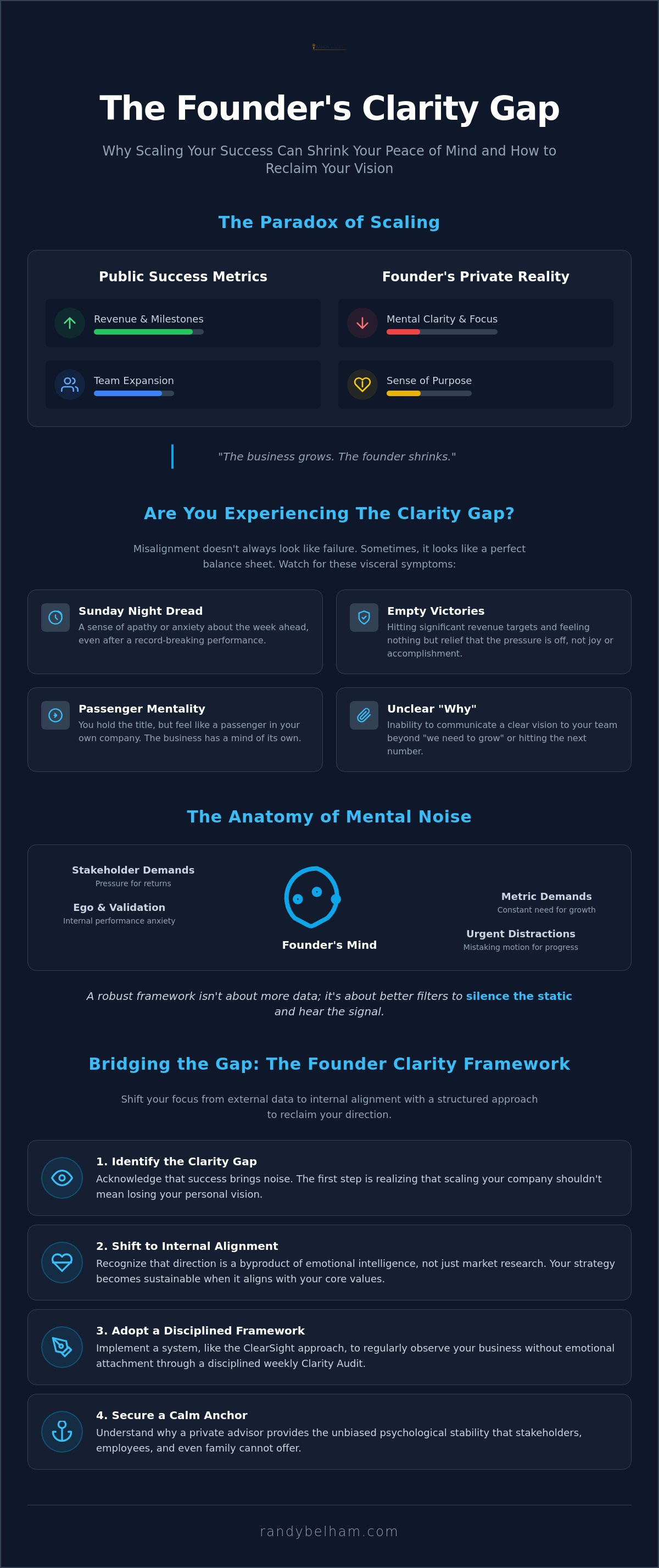
Revenue is up. Your team is expanding. You've reached the milestones you once only dreamed of. Yet, the fog is thicker than ever. This is the Clarity Gap. It's the silent distance between your daily operations and your original vision. Success didn't bring peace. It brought complexity. More growth creates more noise, not more clarity. It's a cruel paradox that many Canadian entrepreneurs face as they scale past the initial hustle. The business grows. The founder shrinks.
When the pressure mounts, it's easy to mistake "busy-ness" for direction. You're in back-to-back meetings. You're answering late-night messages. You're putting out fires. It feels like progress, but it's often just motion. Without a founder clarity framework, you're merely reacting to the loudest voice in the room. The cost is high. Innovation stalls when you're too tired to think. Your team feels the friction. They see the targets being hit, but they sense the lack of soul behind the numbers. Eventually, the engine begins to seize.
The Anatomy of Mental Noise
Noise isn't just volume. It's the weight of expectations. Stakeholders demand returns. Metrics demand attention. Your ego demands validation. These forces compete for space in your mind, leading to over-analysis in the boardroom. You spend hours debating minor pivots while the major shifts go unnoticed. While many understand what is strategic planning at an operational level, they often lack the mental filter to separate urgent distractions from important signals. True leadership requires the ability to silence the static and hear the signal. A robust founder clarity framework isn't about more data; it's about better filters.
Recognizing the Symptoms of Misalignment
Misalignment doesn't always look like failure. Sometimes, it looks like a perfect balance sheet. You might feel like a passenger in your own company. You hold the title of CEO, but the business seems to have a mind of its own. It's moving, but you aren't the one steering. Other symptoms are more visceral:
A sense of dread or apathy on Sunday nights, even after a record-breaking week.
Hitting significant revenue targets and feeling nothing but relief that it's over.
The inability to communicate a clear "why" to your executive team beyond "we need to grow."
When you can't articulate the vision, your team can't follow it. They start making safe bets instead of bold moves. The "inner game" is being lost. To fix the business, you must first clear the mental fog. A structured approach provides the tools to bridge this gap, turning success back into a source of energy rather than a source of exhaustion.
The Psychology of Founder Direction and Decision Making
External data is a tool. Internal alignment is the engine. Most founders look for answers in market research or competitor analysis. They should look in the mirror. Direction is not found in a pivot table. It's found in the quiet space between your thoughts. A founder clarity framework isn't just a business plan; it's a psychological anchor. It recognizes that your business cannot outgrow your own mental state. If you are unsettled, your strategy will be erratic. Alignment is the source of all sustainable momentum.
Strategic choices are rarely purely logical. They are deeply emotional. Your emotional intelligence (EQ) dictates the quality of every decision made in the boardroom. If you are operating from a place of fear or ego, your choices will reflect that tension. You'll hire too fast. You'll pivot too soon. You'll ignore the red flags. Scaling requires the ability to hold space for uncertainty without rushing to fill it with noise. The "inner game" is the only game that truly matters. Master your internal landscape, and the external landscape follows.
Breaking the Cycle of Overthinking
Overthinking is a physiological trap. When the stakes are high, your body reacts. Cortisol spikes. Your perspective narrows. You move from CEO to firefighter in a matter of seconds. This reactive state is the enemy of vision. To lead effectively, you must move back to a proactive centre. It involves recognizing the physical signals of stress before they cloud your judgment. Breaking the loop requires a disciplined pause. If you find yourself trapped in a mental spiral, learn how to stop overthinking business decisions by refocusing on your core values.
The Power of Presence in Leadership
Presence is your most valuable filter. It allows you to ignore the non-essential and focus on what moves the needle. In a volatile market like Montreal, being the "calm anchor" is a competitive advantage. Investors don't just fund business models. They fund the person steering the ship. A clear mind improves team culture and builds deep investor trust. This intersection of strategic leadership and vision is where high-performing founders operate. When you are present, you don't just see the problems; you see the path through them.
If the noise of scaling is starting to drown out your original purpose, exploring a private advisory relationship can provide the perspective needed to reclaim your edge.
Business Strategy vs. Founder Vision: The Critical Distinction
The strategy is flawless. The vision is fractured. You've optimized the sales funnel, but you've lost the thread of why you started. This is a common trap in the Canadian tech and service sectors. Strategy is the "how." It is operational, tactical, and metric-driven. Vision is the "where" and the "why." It is existential. When you confuse the two, you begin to optimize for a void. A perfect strategy cannot save a business if the founder’s vision is clouded by ego or external expectations. You end up with a high-performing machine that is heading in the wrong direction.
Your business is a vehicle. It is not the ultimate destination. Many high-achievers treat their companies as an extension of their identity. When the company struggles, their self-worth collapses. When the company succeeds, their ego expands. Neither state is conducive to clear-headed leadership. Sustainable growth requires realigning your personal values with your corporate objectives. You must ensure the vehicle is taking you somewhere you actually want to go. A robust founder clarity framework helps you maintain this distinction, keeping the "inner game" stable while the "outer game" fluctuates.
Auditing Your Current Direction
Clarity requires an honest audit. You must distinguish between founder-led goals and ego-led goals. Ego-led goals are often about validation, market dominance, or "unicorn" status. Founder-led goals are about impact, legacy, and personal fulfillment. Ask yourself: "Am I building what I want, or what I think a successful CEO should build?" This level of honesty is difficult. It requires developing a founder’s mindset that prioritizes truth over optics. If the audit reveals a gap, you don't need a new strategy. You need a renewed vision.
Closing the Distance to Your Vision
Closing the gap often involves pruning. You must let go of projects that are profitable but misaligned. This is the hardest part of high-stakes leadership. It feels counterintuitive to cut a "successful" venture, yet keeping it creates mental noise. Once you realign, you must communicate this renewed clarity to your board and employees. They need to see the "why" behind the "how." Managing the fear of letting go is part of the process. Within a founder clarity framework, pruning is not seen as a loss. It is seen as an investment in focus. You are clearing the path so the vision can breathe again.
Practical Frameworks for Reclaiming Your Clarity
Distance is the objective. ClearSight is the method. Most founders are too close to the gears to see the machine. You're a tenant in your own company when you should be the architect. Emotional attachment creates the fog. When every pivot feels like a personal failure, you lose the ability to lead. A founder clarity framework provides the structural distance needed to observe. It allows you to audit the operations without the panic of being inside them. You see the movement. You identify the friction. You realize the solution.
Implementation requires a "Clarity Audit." Make it a weekly leadership routine. Every Friday afternoon, step away from the dashboard. Ask three questions. What moved the vision forward? What created unnecessary noise? Where did I lose my mental centre? This is not a status update. It is a psychological review. It identifies the moments where you shifted from proactive leader to reactive firefighter. For many, this process is best facilitated by an executive decision making coach montreal who can act as a neutral observer.
Environment dictates thought. The office is for execution. It is the worst place for vision. Your brain associates the boardroom with fires, stakeholders, and immediate demands. To see the long horizon, you need a different view. A quiet room. A long walk. A space where the phone is silent. Change the physical input to change the mental output. Visionary work requires silence that the modern office cannot provide.
The Unflinching Routine
Protect your bandwidth. Decision fatigue is real. If you spend your morning answering trivial emails, you've already drained the tank. Your first hour belongs to the vision. Create a non-negotiable block for deep work. No meetings. No notifications. Just the "inner game." This isn't about bio-hacking. It's about decision preservation. By automating the mundane, you save your energy for the high-stakes choices that define your company's future. Direction is a finite resource. Spend it wisely.
Building Mental Resilience
The fog will return. A crisis will hit. A key hire will leave. Resilience is not the absence of stress. It is the speed of your return. How fast can you find your centre after a board meeting goes sideways? Building Entrepreneur mental resilience involves recognizing the physiological spike of a crisis and having a plan to breathe through it. It's the ability to recalibrate in real-time. If you feel the fog closing in, private advisory can help you build the systems to stay grounded.
The Role of a Private Advisor in Founder Performance
Leadership is isolation. You're surrounded by people, yet you're alone in every high-stakes decision. Stakeholders want returns. Employees want security. Everyone has an agenda. You need a calm anchor. You need someone who is not a stakeholder. Someone who isn't on the payroll. A private advisor provides the psychological distance your team cannot offer. They don't just look at the business; they look at you. Implementing a founder clarity framework requires this level of external objectivity. It's the difference between being tossed by the storm and steering through it with a steady hand.
This need for objective, high-level guidance extends to all facets of a leader's portfolio, including real estate, where firms like Steve Kooner & Associates provide the strategic oversight necessary for complex residential and commercial transactions.
There is a critical distinction between a consultant and an advisor. A consultant is operational. They build systems. They audit processes. They fix the "how." An advisor is psychological. They audit the founder. They fix the "where" and "why." 1:1 advisory creates a space of total safety. It's where you can admit the uncomfortable truths you can't tell the board. You can speak the fear. You can acknowledge the apathy. This is why founder performance coaching is a competitive advantage. It ensures the person at the helm is as disciplined as the company they lead. Success without sanity is a failure. Performance without purpose is just a treadmill.
The Value of an External Perspective
You cannot see your own blind spots. You're too close to the noise. Your team is often too invested in the current direction to challenge it effectively. They want to please you. They want to keep their roles secure. An advisor sees the patterns you've grown blind to over years of scaling. In a market like Montreal, the tensions are specific. Culture, language, and rapid growth create a unique pressure cooker. A local advisor understands these nuances. They offer the psychological safety of an exclusive, limited-client relationship. You aren't just another file in a CRM. You are one of ten. This exclusivity ensures depth. It ensures presence.
Taking the First Step Toward Clarity
Waiting for "the right time" is a trap. It's a symptom of the Clarity Gap. If you're waiting for the noise to stop before you seek direction, you'll be waiting forever. The noise only stops when you decide to lead through it. Moving from reactive chaos to grounded authority is a choice. It starts with a conversation. Realize your vision by closing the gap between who you are and how you lead. The business will follow the founder. If you are ready to reclaim your edge, connect with Randy for a private advisory session to realize your vision.
Mastering the Inner Game of High-Stakes Leadership
The metrics are clear. The mind is not. You've mastered the external game of scaling, but the internal game is where the true battle lies. Closing the Clarity Gap isn't about adding more tasks to your dashboard. It's about removing the noise that prevents you from seeing the path forward. Success feels heavy. Vision should feel light. When you lose that lightness, you lose your edge.
A structured founder clarity framework provides the mental map you need to lead with grounded authority. It separates the "how" of business strategy from the "why" of your original vision. By implementing a disciplined routine and seeking an external perspective, you turn decision fatigue into decisive action. You move from being a passenger in your growth to being the architect of your future.
Randy Belham offers high-touch private advisory based in the heart of Montreal. With 30 years of business experience, he acts as a peer-level guide for high-achievers. Capacity is strictly limited to 10 clients to ensure deep, personalized focus on your specific challenges. Don't let the fog of success become a permanent state. Explore Private Advisory for Founders and reclaim the direction your leadership deserves. You've built the company. Now, it's time to lead it with total conviction.
Frequently Asked Questions
What is the difference between a business coach and a founder clarity coach?
A business coach typically audits your operations, while a clarity coach audits your internal vision. Business coaching is tactical and metric-driven, focusing on the "how" of your company. Clarity coaching is existential and psychological. It focuses on the founder’s mental centre rather than just the balance sheet. It ensures the person steering the ship is actually heading toward a destination they value.
How do I know if I have a clarity problem or a strategy problem?
Strategy problems look like broken processes; clarity problems look like a broken connection to the work. If you have a clear plan but feel apathetic or dread the execution, you have a clarity problem. You don't need a better spreadsheet. You need a founder clarity framework to realign your personal values with your growth targets and eliminate the fog of success.
Can clarity coaching help with burnout prevention?
Yes, clarity coaching is a primary tool for burnout prevention in high-stakes leadership. Burnout is rarely caused by hard work alone; it is caused by work that feels meaningless or misaligned. By closing the Clarity Gap, you remove the internal friction that drains your energy. This allows you to lead from a state of presence rather than a state of chronic exhaustion.
How long does it typically take to see results in founder direction?
You will often feel an immediate reduction in mental noise after the first session. However, structural shifts in your long-term direction usually take three to six months to fully manifest. Reclaiming your clarity is a methodical process of unlearning reactive habits and building the mental resilience required to stay focused during a crisis.
Is clarity coaching relevant for founders of established companies or just startups?
Clarity coaching is essential for founders at every stage of the business lifecycle. Startups face the noise of uncertainty, while established companies face the noise of success. High-stakes leadership in an established firm often leads to a disconnect between the original vision and current operational complexity, making a founder clarity framework vital for sustainable scaling.
What should I expect during a private advisory session for clarity?
Expect a direct and unflinching exploration of your current mental state and business alignment. A private advisory session is a safe space to discuss uncomfortable truths that you cannot share with your board or executive team. It is a focused, one-on-one conversation designed to move you from a reactive state toward a sense of grounded authority.
How does emotional intelligence impact my ability to find direction?
Your emotional intelligence (EQ) is the filter through which every strategic choice passes. If your EQ is clouded by fear or ego, your decisions will be erratic and reactive. High EQ allows you to observe your business without emotional attachment. This clarity of mind leads to sharper focus, better team culture, and more sustainable long-term direction.
Why is it important to have an advisor who has business experience?
Business experience creates a peer-level understanding of the weight of leadership. An advisor who has navigated the pressure of high-stakes environments offers more than just theory; they offer empathy. They understand the visceral reality of decision fatigue and the hidden burdens of being the final decision-maker. This shared experience creates an atmosphere of professional maturity and safety.


Comments