
Founder Advisory Services: Finding a Private Mirror for the Inner Game

Updated: Aug 11
A few months ago, I sat with a founder in Montreal who had just finalized a deal that most would consider a career defining moment. Despite the congratulations and the press releases, he felt a quiet, persistent exhaustion that he couldn't quite name to his board or his executive team. He mentioned that the more his influence grew, the smaller his world of true confidants seemed to become. It was as if the noise of his success had begun to drown out his own voice.
It's a familiar tension for those at the top of a growing organization. One might realize that the very success they built creates a layer of noise that obscures their original clarity. This discussion examines the considerations involved in seeking out founder advisory services to provide a confidential space for processing high stakes decisions. It is a reflective inquiry into how one might remain at the centre of their vision without losing themselves to the pressure of the inner game.
Table of Contents
The isolation inherent in the building process
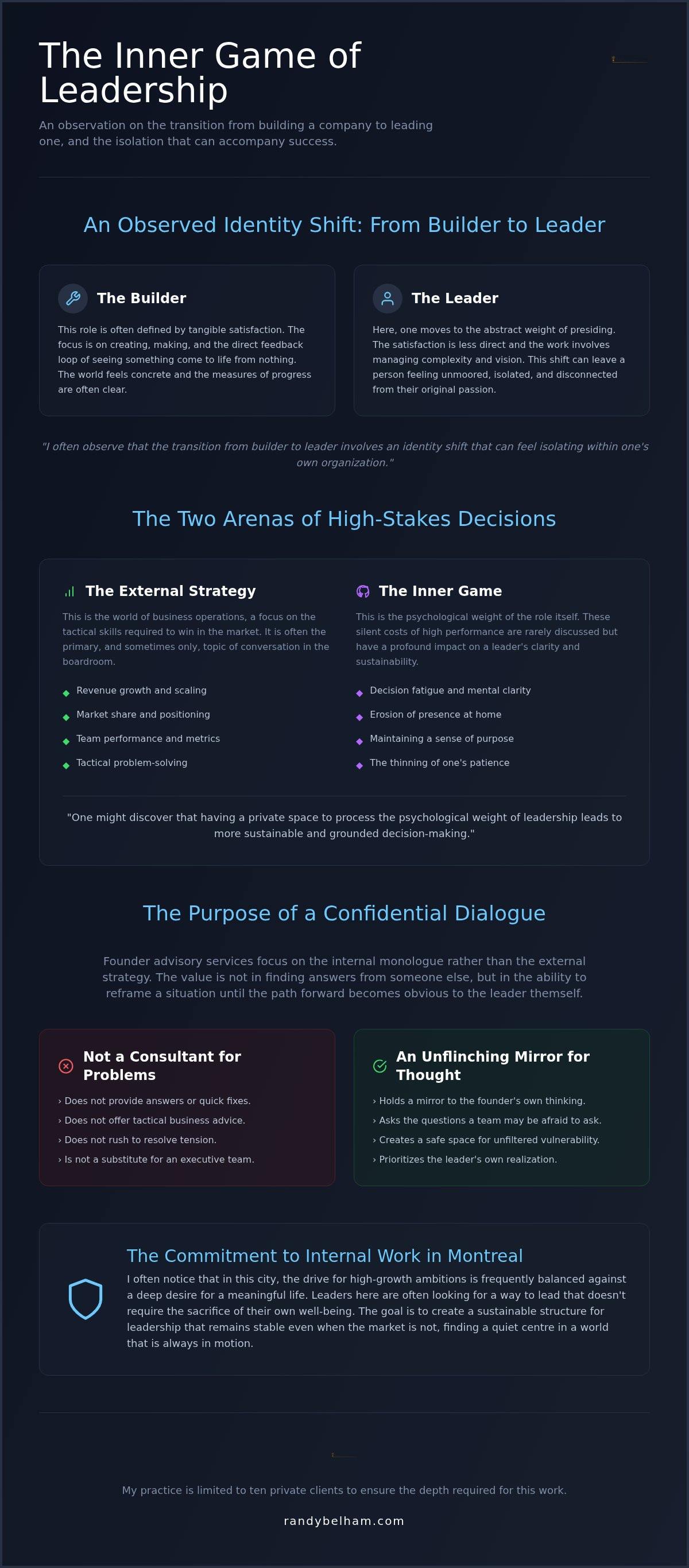
I sat with a founder recently who described the board room as the loneliest place in the city. He had built something remarkable, yet he felt a profound sense of isolation that his peers couldn't quite grasp. This is a common observation in my work with high-performers. The transition from builder to leader often requires a shift in identity that many are unprepared to make. One moves from the tangible satisfaction of creating to the abstract weight of presiding, which can leave a person feeling unmoored from their original passion.
External metrics of success often mask an internal sense of drift or exhaustion. It's entirely possible to win the market while losing one's own sense of purpose. While many look toward business and executive coaching to refine their tactical skills, founder advisory services offer a different kind of mirror. The weight of leadership is not a problem to be solved; it is a reality to be managed with intention. Recognizing this distinction allows a leader to step back from the noise of the organization and look at the person holding the vision.
Recognizing the silent costs of high-performance leadership
We often talk about revenue growth and scaling, but we rarely discuss the erosion of presence at home or the thinning of one's patience. Decision fatigue acts as a quiet thief, stealing the clarity needed for the next big move before the day has even begun. I observe that the most successful founders are often the ones most at risk of losing their centre. They are surrounded by voices that demand answers, leaving little room for the quiet required to ask the right questions of themselves.
This pressure to scale can often overshadow personal financial health, making it difficult to see the rewards of one's hard work. For a more holistic approach to wealth, you might visit The Bucket List Accountant to see how financial advisory can help you regain focus on what truly matters.
Identifying the qualities of a private advisor
Selecting a partner for this work is perhaps one of the most personal decisions a founder will make. It requires more than a review of a resume or a list of past exits. A true partnership requires a space where the executive mask can be set aside safely, allowing the person behind the title to speak without filter. I find that this level of vulnerability is rare in the high stakes environments where most leaders operate, yet it is essential for long term psychological health.
This is why effective founder advisory services focus on the internal monologue rather than just the external strategy. Recent reports on the mental health toll on founders suggest that the pressure to maintain an image of constant strength is often what leads to burnout. I observe that the relationship should feel less like a consultancy and more like a confidential dialogue between peers who understand the unique weight of the role. It is a space where the inner game is the primary focus.
The necessity of an unflinching mirror
I find that the best advisors do not offer answers, but rather hold a mirror to the founder's own thoughts. Does the person across from you have the grit to ask the questions your team is afraid to ask? A confidential advisor must be able to sit in the tension of an unresolved problem without rushing to a fix. This requires a level of professional maturity that prioritizes the leader's own realization over the advisor's need to appear helpful.
The value lies in the ability to reframe a situation until the path forward becomes obvious to the leader. If you are looking for a space to examine these dynamics, you might consider how 1:1 private coaching could support your process. It is about finding a quiet centre in a world that is always in motion, allowing for a more grounded approach to the challenges that lie ahead.
The commitment to the internal work in Montreal
Montreal has a unique entrepreneurial energy that requires a specific kind of resilience. I often notice that in this city, the drive for high growth ambitions is frequently balanced against a deep desire for a meaningful life. It is a tension that is particularly visible among those who seek out founder advisory services to help them manage the complexity of their roles. They aren't just looking for business growth; they are looking for a way to lead that doesn't require the sacrifice of their own well-being.
I choose to limit my practice to ten private clients because this level of deep work cannot be mass produced. When we are looking at the foundational aspects of a person's leadership, the conversation requires a degree of attention that is impossible to sustain across a large roster. The goal is to create a sustainable structure for leadership that lasts well beyond the current quarter or the next funding round. It is about building a foundation that remains stable even when the market is not.
Sustaining the human behind the high performance executive
In our sessions, we look at the habits that either support or sabotage the vision you have for your life. Leadership in Montreal is often about finding a grounded authority amidst the noise of a rapidly changing market. I wonder what might change if you had a space where your performance was not the only metric that mattered. It is often in that quiet space, away from the pressure of quarterly results, that the most significant insights regarding one's centre begin to emerge.
Cultivating the space for your next evolution
We've explored how the isolation of the boardroom often stems from a shift in identity that few are prepared for. A confidential partner who acts as an unflinching mirror allows you to set aside the executive mask and process the psychological weight of your role. My work in Montreal is rooted in 30 years of business experience and 20 years of coaching, where I focus on the internal mechanics of leadership.
To maintain this high-touch support, I limit my practice to ten private clients. This focus ensures that founder advisory services remain a deep, personal inquiry rather than a mass-produced exercise. If this is the kind of conversation you want to have, you know where to find me at randybelham.com. I wonder what might shift in your organization if you allowed yourself the space to simply be the human behind the vision.
Frequently Asked Questions
What is the primary difference between a business consultant and a founder advisor?
A business consultant typically focuses on the operational mechanics of the organization, whereas founder advisory services focus on the human who holds the vision. I observe that while one might fix a process, the other examines the mental models behind the process. This distinction is vital for those who realize that their internal state directly impacts the health of their company.
How do I know if I am ready for private 1:1 advisory services?
Readiness often appears as a realization that the tools used to build a company are no longer sufficient to lead it. I find that many founders reach out when the noise of scaling begins to drown out their own clarity. It is a moment where the need for a confidential space to process high stakes decisions becomes more important than the next tactical win.
Why does Randy Belham limit his private advisory to only ten clients at a time?
I limit my practice to ten individuals because founder advisory services require a level of presence that cannot be mass produced. My 30 years of business experience has shown me that deep work requires a significant investment of time and mental space. Keeping the roster small ensures that every conversation is as thoughtful and focused as the challenges a leader faces.
What themes are typically explored in a confidential advisory session?
Confidential sessions often centre on themes of identity, decision fatigue, and the psychological costs of success. I notice that we frequently examine the habits that either support or erode a leader's sense of presence. The goal is often to look at the person behind the executive title to understand how their inner game influences the outer world of their business.


Comments