
Entrepreneur Mental Resilience: Busting the Myths of the "Tough" Founder

Your balance sheet is healthy. Your internal state is not. You have been told that leadership requires a thick skin and an iron will. So you push. You endure. You ignore the quiet exhaustion that settles in after the office lights go out. This version of toughness is a liability. It is a brittle mask that eventually cracks under the weight of decision fatigue and the "lonely at the top" reality of modern leadership. True entrepreneur mental resilience is not about the capacity to absorb pain. It is about mental elasticity. It is about the ability to bend without breaking.
You already know that the current pace is unsustainable. You feel the gap between your public success and your private burnout. You see the toll it takes on your focus and your health. Discover why the traditional "hustle" mindset fails and how to transition toward a model of empowered leadership. We will explore the mechanics of emotional regulation and how to maintain clarity in high-pressure environments. It is time to trade your armour for a system that supports your long-term growth and professional maturity.
Table of Contents
Myth vs. Reality: Why "Gritting Your Teeth" is Not Resilience
Success is often measured by what you can withstand. Your revenue is climbing. Your clarity is fading. You have been taught that leadership is a war of attrition. You take the punches. You keep standing. You call this resilience. It isn't. It is simply endurance. Gritting your teeth through the pressure is a temporary tactic, not a long-term strategy.
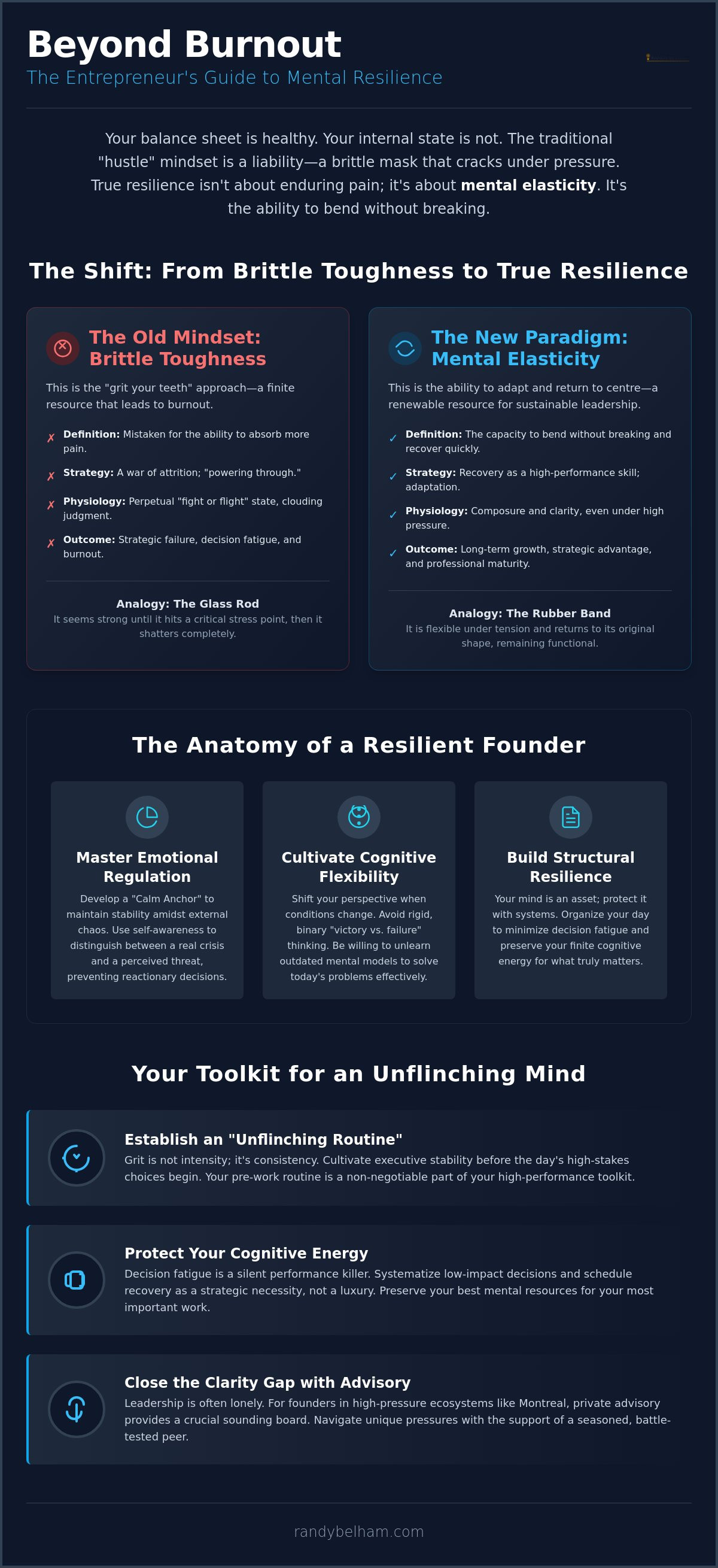
Resilience is often mislabelled as the ability to absorb more pain. True entrepreneur mental resilience is actually about mental elasticity. It is the capacity to return to your centre quickly after a disruption. Think of a rubber band versus a glass rod. The rod is "tough" until it shatters. The band is flexible and remains functional. Psychological resilience involves adapting to adversity through a system of mental and emotional recovery. It is a renewable resource. Toughness, by contrast, is a finite one.
The Endurance Trap
Endurance is about lasting. Resilience is about adapting. The "hustle" narrative suggests that if you just work harder, you will win. This mindset sabotages long-term performance. It forces you into a state of perpetual "fight or flight." Your body doesn't know the difference between a missed funding round and a physical threat. The physiological cost is high. Stress hormones cloud your judgment. You lose the ability to see the "big picture." White-knuckling through founder burnout is not a badge of honour. It is a strategic failure.
Reframing the "Tough" Founder
We need to move from rigid strength to flexible authority. The most effective Montreal leaders realize that recovery is a high-performance skill. They don't just "power through." They build systems to protect their mental state. Grit is not about intensity. It is about consistency. It is the discipline to maintain your composure when the stakes are highest. It is the quiet strength of the "calm anchor."
In a high-pressure environment, your mind is your most valuable asset. If it is brittle, it will crack. If it is elastic, it will thrive. Resilience is built in the quiet moments of reflection, not just the heat of the crisis. It is the difference between a founder who burns out in three years and one who leads for thirty. This shift requires moving beyond the myth of the "tough" founder and embracing the reality of the sustainable leader.
The Anatomy of Mental Elasticity: Beyond the Hustle
Mental elasticity is not a personality trait. It is a biological architecture. You see the growth in your company. You feel the stagnation in your clarity. Building entrepreneur mental resilience requires moving past the "hustle" and into the mechanics of the mind. It is about how you process information under fire. It is about staying fluid when the pressure is solid. You must learn to bend without losing your shape.
High-stakes leadership is noisy. Competing voices. Fluctuating markets. Internal pressures. Self-awareness is your filter. It allows you to see the difference between a real crisis and a perceived threat. This distinction is a competitive advantage. It keeps you from reacting to shadows. When you understand your own triggers, you stop being a passenger to your emotions. You become the pilot.
Cognitive Flexibility in Leadership
Your strategy pivots. Your thoughts should too. Cognitive flexibility is the ability to shift your perspective when the environment changes. Many founders fall into binary thinking. They see only "victory" or "failure." This rigidity is dangerous. It prevents you from seeing the third way. You must realize when your mental models are outdated. If you are solving today's problems with yesterday's fears, you are already behind. A comprehensive founder's guide to mental resilience suggests that the "mental athlete" treats cognitive training with the same rigour as business operations. It is about unlearning as much as learning.
Presence and the Calm Anchor
Presence is often misunderstood. It is not about being the loudest person in the room. It is about being the most grounded. In the Montreal boardroom, presence is your "calm anchor." It is the internal quiet that persists despite the external chaos. Before a high-stakes negotiation, ground yourself. Focus on the mechanics of your breath. Notice the physical weight of your responsibility. This presence reduces the "noise" of leadership. It allows for precise execution and emotional regulation under fire.
This level of mastery is difficult to achieve alone. Most high-performers are blind to their own patterns. They operate within a "Clarity Gap" where their habits sabotage their goals. Addressing this gap is the first step toward Empowered Leadership. It is about refining the "inner game" to ensure your entrepreneur mental resilience remains a sustainable asset for the long term.
Structural Resilience: Building Systems to Support the Mind
Mindset is the engine. Systems are the chassis. You can have a high-performance engine, but without a frame, the car won't move. Many founders focus solely on mental strength. They ignore the architecture of their day. This is a mistake. Willpower is a finite resource. It depletes with every decision. By the time you reach the afternoon boardroom, you are already exhausted. This is where entrepreneur mental resilience often fails. It fails because it relies on effort instead of structure.
If your day is a series of reactive choices, you are burning cognitive fuel on the mundane. You must build a structure that protects your focus. You need a system that allows you to remain the "calm anchor" even when the external environment is in flux. Resilience is not just a feeling. It is a design choice.
Designing for Decision Fatigue
Decision fatigue is the silent killer of executive clarity. Every choice has a cost. What you wear. What you eat. How you sequence your morning. The most effective CEOs automate these variables. They preserve their "yes" for high-impact strategy. They use the "power of no" to guard their calendar. To master mental resilience, you must design a routine that serves your energy levels. If you are a morning person, don't schedule low-stakes vendor calls at 9:00 AM. Use that time for deep work. Build a chassis that carries the weight of your ambition without buckling.
Closing the Clarity Gap
Friction is often invisible. You feel the drag, but you can't see the source. This is The Clarity Gap. It is the distance between your strategic vision and your daily execution. When this gap is wide, your mental energy leaks into the void. To close it, you need structured reflection. This is not "thinking." It is a systematic audit of your leadership style and operational habits. The Clarity Gap is a structural tool used to identify the psychological and operational misalignments that drain a founder's mental energy. Use these points to realize where your entrepreneur mental resilience is being compromised:
Identify recurring friction points in your weekly schedule.
Audit your current boundaries for digital communication.
Assess if your systems support your recovery as much as your output.
Hard boundaries are non-negotiable. They are the firewalls for your mind. No Slack after 7:00 PM. No meetings on Fridays. These aren't luxuries for the successful. They are structural requirements for executive stability. Without them, your mental elasticity becomes permanent deformation. You lose the ability to return to centre. Build the system. Protect the engine.
The Habits of the Unflinching Founder
Resilience is not a crisis response. It is a daily practice. You see the chaos of the market. You feel the pressure of the deadline. Most founders wait for the storm to test their strength. The unflinching founder builds that strength when the sky is clear. True entrepreneur mental resilience is forged in the quiet moments; the habits you maintain when no one is watching. It is the discipline of the "inner game."
Your schedule is crowded. Your mind is cluttered. Without deliberate habits, you are merely reacting to other people's priorities. You need an Unflinching Routine. This is a sequence of non-negotiable actions that ground your executive stability. It starts with digital hygiene. The 24/7 ping of notifications is a cognitive drain. It creates a state of continuous partial attention. Protecting your mind from this noise is the first step toward sustained clarity.
The Rhythms of High Performance
Morning rituals should prioritize clarity over reactivity. Don't check your email before you have checked your pulse. Start with presence. Move with intention. This sets the tone for the boardroom. Similarly, evening shutdowns are essential. You must learn how to stop thinking about work at night. If your brain is still processing spreadsheets at midnight, you aren't resting. You are just waiting. Physical wellness is the foundation here. Your mental elasticity depends on your physiological state. A tired body cannot support a resilient mind.
Sustainable Habit Formation
Resilience is a muscle. You build it through small wins. Many leaders fall into the "all-or-nothing" trap. They try to overhaul their entire life in a weekend. They fail by Monday. Instead, focus on consistency over intensity. Leverage the principles of habit formation for entrepreneurs to ensure your progress is permanent. This is how you cultivate entrepreneur mental resilience that lasts for decades, not just quarters. It is about creating a system that sustains greatness without requiring constant willpower.
Deep work blocks are your strategic sanctuary. These are periods of time where the world is locked out. No pings. No interruptions. Just high-level focus on the Clarity Gap. This is where the real work of leadership happens. If you cannot find two hours of quiet in your day, you aren't leading. You are just managing. It is time to reclaim your focus. If you are ready to refine these habits and master your inner game, consider 1:1 Private Coaching to accelerate your growth.
Navigating the Inner Game: Why Montreal Founders Seek Advisory
Montreal is a city of layers. Historic architecture. Modern disruption. The startup culture here is high-stakes and bilingual. You see the success stories on Saint-Laurent. You feel the internal weight in your own office. This is the reality of entrepreneur mental resilience in a competitive hub. It is localized. It is personal. The pressure to scale is constant. The fear of stagnation is real. You are expected to be the "tough" founder while navigating a landscape that changes by the hour.
In this fast-paced environment, many executives find that professional media production through Aflalo Communications Inc. helps them maintain a consistent, high-quality presence without adding to their cognitive load.
Similarly, maintaining the physical integrity of your properties is a vital part of reducing daily friction; for expert assistance, you might check out First Choice Plus Plumbing & Air to handle your HVAC and plumbing needs with professional precision.
A private advisor is the "secret weapon" of the top 1%. They provide an objective, battle-tested perspective that your internal circle cannot offer. Most founders operate in a vacuum. They have no one to mirror their thoughts without an agenda. An advisor acts as that mirror. They help you navigate the "inner game" while you manage the external one. This moves you from isolation to supported leadership. It is the difference between surviving a quarter and sustaining a decade of growth.
The Isolation of the Founder
Leadership is often a performance. You cannot always be "real" with your board. They have financial expectations. You cannot show every crack to your team. They need a sense of stability. This creates a wall. It leads to a profound sense of isolation that drains your mental energy and compromises your decision making. A confidential, high-level sounding board offers more than just business strategy. It offers psychological relief. Utilizing founder isolation support changes your leadership trajectory. It allows you to process the hidden burdens of authority in a safe, professional space. You stop performing. You start refining.
Selecting a Private Partner
Generic coaching is a commodity. It relies on templates and high-energy hype. High-touch advisory is an investment in your cognitive architecture. It is bespoke. Randy Belham understands the weight of the "Clarity Gap" and the unique pressures of the Montreal ecosystem. This is why he limits his practice to exactly ten founders at any given time. This restriction ensures maximum depth. It allows for a peer-to-peer relationship rather than a distant consultancy. You don't need another person to tell you how to work. You need a "calm anchor" to help you realize how you are thinking.
The goal is not to work harder. The goal is to lead with more presence and structural quiet. If you are ready to close the gap between your public success and your private exhaustion, it is time for a different approach. Explore Private Advisory with Randy Belham. Reclaim your clarity. Secure your legacy.
Beyond the Armour: Securing Your Leadership Legacy
Leadership is often a performance of strength. Success is frequently a mask for exhaustion. You have seen why gritting your teeth is a liability, not an asset. True entrepreneur mental resilience is found in mental elasticity. It is the capacity to return to your centre quickly after a disruption. It requires moving from rigid endurance to a system of structural support that protects your clarity. You must close the gap between your public success and your private fatigue. Build a chassis that can actually carry the weight of your ambition.
This journey doesn't have to be solitary. Randy Belham offers a grounded, battle-tested perspective for Montreal based founders. With 30 years of business experience, he provides exclusive 1:1 advisory focused on the "inner game" of high performance. This work is limited to ten clients to ensure maximum depth and professional maturity. It is time to trade your armour for a system that actually works. Secure one of the ten exclusive advisory spots with Randy Belham. You've built the business. Now, build the mind that can lead it for the long term.
Frequently Asked Questions
What is entrepreneur mental resilience?
Entrepreneur mental resilience is the capacity for mental elasticity. It is the ability to return to your centre quickly after a disruption or high-stakes setback. Unlike simple endurance, which is about absorbing pain until you break, resilience is a renewable system. It involves using cognitive flexibility and emotional regulation to maintain your "calm anchor" while the external business environment is in motion.
How can I tell if I am experiencing founder burnout?
Burnout often manifests as a widening gap between your public success and your private exhaustion. You might experience chronic decision fatigue where even mundane choices feel heavy. Other signs include a loss of presence in your personal life and a sense of being "lonely at the top." When your mental models become rigid and you stop seeing the "third way" in negotiations, your resilience is likely compromised.
Can mental resilience be learned, or is it an innate trait?
Resilience is a skill that is developed, not a fixed personality trait. It is built through the "inner game" of habit formation and structural design. While some people may have a natural baseline for stress, true entrepreneur mental resilience is a renewable resource. You cultivate it by establishing an Unflinching Routine and closing the Clarity Gap through consistent, structured reflection.
How do I stop overthinking business decisions at night?
Establish a hard evening shutdown routine that separates your identity from your output. Digital hygiene is critical here; stop checking Slack or email at a set time, such as 7:00 PM, to allow your nervous system to exit "fight or flight" mode. Offload your mental friction by writing down the next day’s primary strategic focus before you leave the office. This creates a psychological boundary that protects your sleep.
What are the best leadership habits for founders to build resilience?
The most effective habits prioritize clarity over reactivity. Start your morning with a ritual that grounds your presence before you engage with the noise of the market. Protect your schedule with deep work blocks for high-level strategy. Finally, automate mundane choices to preserve your cognitive energy for the decisions that actually move the needle for your company.
How does a private advisor help with mental resilience?
An advisor acts as an objective mirror for your internal monologue. They provide a confidential, high-level sounding board that your board or team cannot offer. By identifying the friction points in your leadership style, an advisor helps you move from isolated endurance to supported leadership. This battle-tested perspective allows you to see your own patterns before they lead to burnout.
Why is Montreal a unique environment for entrepreneur stress?
Montreal is a high-stakes, bilingual ecosystem with dense competition. Founders here must navigate the complexities of scaling globally while managing local cultural and regulatory nuances. This dual pressure creates a specific type of cognitive friction. The "lonely at the top" feeling is often amplified in such a tightly knit but competitive startup culture.
How long does it take to see results from resilience coaching?
Results are both immediate and cumulative. You will often feel a sense of psychological relief after the first confidential advisory session. However, building the "resilience muscle" through habit formation is a rhythmic process. Most founders realize significant shifts in their executive stability and clarity within three to six months of consistent focus on their inner game.


Comments